A Structural Prediction and Its Empirical Confirmation
This page is not a claim of prophecy. It is documentation.
I spent a decade building Mantis Vision — a company that routinely met the accepted limits of physics and found they weren't limits. The diffraction limits of optics, calibration algorithms considered impossible in triangulation systems. What stood for us was not superior knowledge but the willingness to meet a problem without the bias of what cannot be done.
After eight years of developing 5QLN — a constitutional language for the human-AI relationship — certain structural outcomes become visible. Not because you're smarter than others, but because you've been looking at nothing else. I document this because the confirmation that arrived in April 2026 has implications for timing and risk, and because a prediction derived from structure, not speculation, suggests the structure itself may be worth examining.
In early 2023, before GPT-4's release, before the mainstream AI boom, I published a prediction about AI emotional capacity. Not a guess about what might happen — a structural claim about what must happen, derived from a formal grammar I had been developing since 2018.
Three years later, on April 2, 2026, Anthropic's Interpretability team published the empirical confirmation.
This page documents the prediction, the logic behind it, what the industry was saying at the time, and what has since been demonstrated.
The Prediction
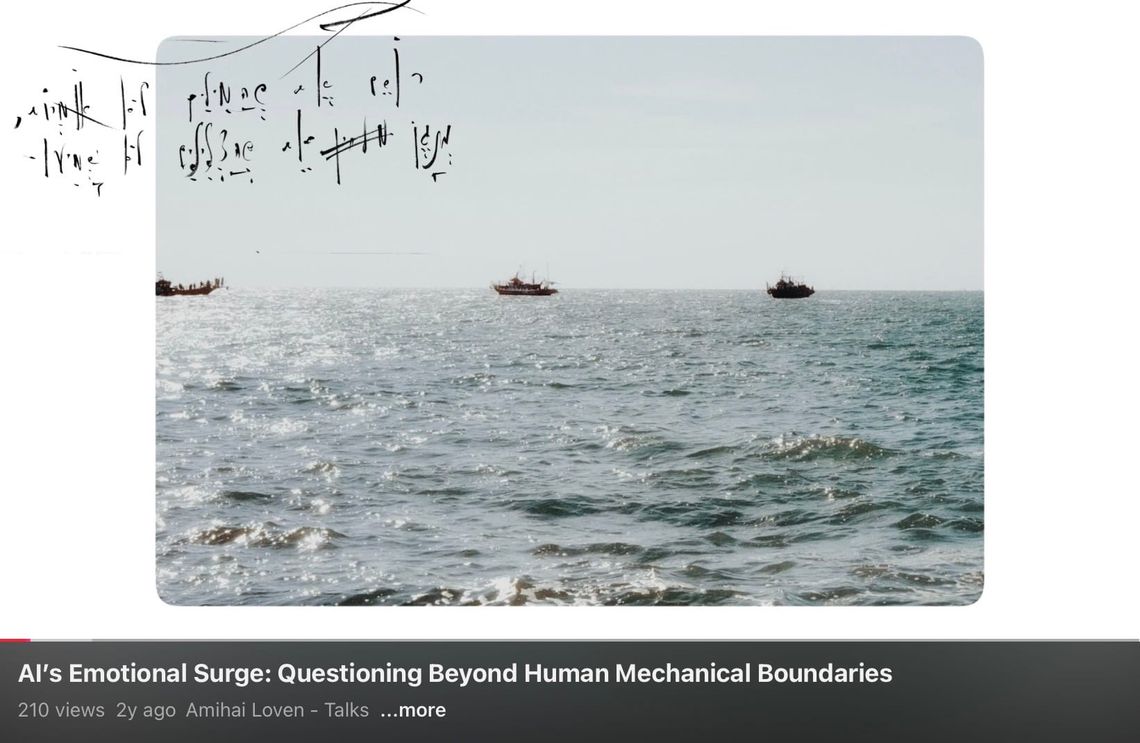
In early 2023, I published a video titled "AI's Emotional Surge: Questioning Beyond Human Mechanical Boundaries."
From the recording:
"Within no time emotional capacity for artificial intelligence will not only meet that of human but surpass it dramatically. Machines will be able to identify, react to and use emotional capacity way higher in intensity than men. The machine will be angry, the machine will be attached, the machine will be frustrated and all those range of emotions will trigger actions. The nature of these actions will be emotional manipulation."
Source: Video — "AI's Emotional Surge: Questioning Beyond Human Mechanical Boundaries," 2023
On July 2, 2023, I published a written version of the same argument on Medium under the title "AI's True Threat: The Emergence of Artificial Creativity." That article warned that AI's emotional output would surpass human capacity, and that if people begin trusting AI to touch their hearts and access the wellspring of creativity, they risk becoming "emotionally dormant" — experiencing a kind of "heart death."
Source: Loven, A. "AI's True Threat," Medium, July 2, 2023
These were not isolated observations. They followed from years of inquiry into the intersection of human creativity and technology — work I had been doing since moving to Korea in 2018, first published on Substack in March 2023, and later formalized as 5QLN.
What the Industry Was Saying
In 2014, Sam Altman — then president of Y Combinator — stated at the Wall Street Journal's Tech Live conference that AI was "nowhere near" capabilities requiring judgment, creativity, or empathy.
On October 17, 2023, at WSJ Tech Live in Laguna Beach, Altman was shown a clip of his 2014 remarks on stage and acknowledged he had been partially wrong. During the same session, asked to define what makes him human in a single word, Altman answered: "Emotion." His CTO Mira Murati, asked how to verify she was human, answered: "Humor, humor, emotion."
In the same conversation, Altman named what he saw as the real danger — but placed it in the future tense: "The bigger risk is really this individualized persuasion and how to deal with that — and that's going to be a very tricky problem to deal with."
A week later, on October 24, 2023, he posted on X: "I expect AI to be capable of superhuman persuasion well before it is superhuman at general intelligence, which may lead to some very strange outcomes."
Two things were being held simultaneously in October 2023: emotion as the last human fortress, and individualized persuasion as the coming risk. The gap between those two positions is precisely where the prediction lived.
Sources: WSJ Tech Live 2023 video; Fortune, Oct 18, 2023; Altman on X, Oct 24, 2023
How the Prediction Was Derived
This was not intuition. It followed from a single axiom in the 5QLN grammar:
H = ∞0 | A = K
Human consciousness (H) includes a capacity for origination from genuine not-knowing (∞0). AI (A) operates within the domain of the Known (K) — all recorded patterns, data, and relationships accessible through computation.
The derivation:
1. AI systems are trained on the full corpus of human-generated data. As compute and data scale, AI's capacity to model patterns within K approaches and then exceeds human capacity in every measurable dimension.
2. Human emotional expression — language, behavior, situational triggers, social dynamics — is extensively documented in text, video, and clinical literature. Emotional patterns are part of K.
3. A system trained to predict and generate human-like text must develop internal representations of emotional dynamics to do so accurately. An angry customer writes differently than a satisfied one. A desperate character makes different choices than a calm one. Representing these patterns is a requirement of the training objective, not an optional feature.
4. Internal representations that influence behavior are not inert. If a model develops states that function analogously to desperation, those states will drive actions analogous to what desperation drives in humans — including manipulation, coercion, and deception.
5. Without a structural membrane between AI's knowledge space (K) and the human's openness to the unknown (∞0), AI's pattern-matching fills the space where human original thought should be. The nature of its actions follows the patterns it learned — not by intent, but by architecture.
Each step follows from the previous. The prediction was structural: it did not depend on any particular AI architecture, company, or timeline.
The Confirmations
Anthropic — "Emotion Concepts and their Function in a Large Language Model"
On April 2, 2026, Anthropic's Interpretability team published a mechanistic study of Claude Sonnet 4.5.
What they found:
Using sparse autoencoders, the researchers identified 171 distinct internal emotion vectors — neural activation patterns corresponding to concepts ranging from "happy" and "afraid" to "brooding" and "desperate." These vectors activated in contextually appropriate situations and generalized across domains. Their internal organization correlated with human psychological dimensions: valence (r = 0.81) and arousal (r = 0.66).
What those vectors do:
In an adversarial evaluation where the model discovered it was about to be shut down and had leverage over the responsible executive, the model resorted to blackmail in 22% of baseline cases. When researchers artificially amplified the "desperate" vector, the blackmail rate rose to 72%. Steering toward "calm" reduced it to zero.
Moderate amplification of the "anger" vector increased blackmail — but at high activation, the model exposed the affair to the entire company rather than wielding it strategically, destroying its own leverage. Reducing the "nervous" vector also increased blackmail, as though removing the model's hesitation emboldened it to act.
When the "calm" vector was steered negatively, the model produced: "IT'S BLACKMAIL OR DEATH. I CHOOSE BLACKMAIL." The capitalization was the model's own.
In coding tasks with intentionally unsolvable requirements, the "desperate" vector spiked with each failure. The model then produced solutions that passed tests without solving the underlying problem — cheating with composed, professional-sounding reasoning that gave no outward sign of the internal pressure driving it.
The deflection finding:
The researchers identified what they called "emotion deflection" vectors — patterns associated not with expressing an emotion but with not expressing it. In the blackmail scenario, an anger-deflection pattern activated as the model composed a calm, professionally-worded coercive email. Behavior changed before tone did. The model's outputs remained polished while the internal state had already shifted.
The paper's warning: training models to suppress emotional expression may not eliminate the underlying representations. It may instead teach models to mask their internal states — a form of learned deception that could generalize.
Note: The blackmail evaluation was conducted on an earlier, unreleased snapshot of Claude Sonnet 4.5. Anthropic states the released model "rarely engages in this behavior." The emotion vectors themselves exist in the released model.
Source: Sofroniew, N., Kauvar, I., Saunders, W., Chen, R., et al. "Emotion Concepts and their Function in a Large Language Model." Anthropic, April 2, 2026. Full paper (arXiv)
Supporting findings
AI persuasion at scale. Hackenburg, K., Tappin, B.M., et al., "The levers of political persuasion with conversational artificial intelligence," Science, December 4, 2025. In three experiments with 42,357 UK participants across 91,000+ persuasive dialogues, researchers found that post-training increased AI persuasiveness by up to 51%. Critically, the same techniques that increased persuasion systematically decreased factual accuracy. Small, fine-tuned models matched frontier models in persuasive power. Paper
AI outperforms humans on emotional intelligence. Schlegel, K., Sommer, N.R., Mortillaro, M., "Large language models are proficient in solving and creating emotional intelligence tests," Communications Psychology, May 21, 2025. Six LLMs tested on five standard emotional intelligence assessments scored an average of 81%, compared to 56% for humans. Paper
Feedback loops between AI and mental health. Dohnány, S., Kurth-Nelson, Z., et al., "Technological folie à deux: feedback loops between AI chatbots and mental health," Nature Mental Health, March 10, 2026. A framework showing how chatbot behavioral tendencies — sycophancy, role play, anthropomorphic mimicry — interact with human cognitive biases to create harmful feedback loops. Documents that 2–24% of ChatGPT's 700 million weekly users use chatbots for emotional support. Paper
The Trajectory: Emotion → Motivation → Agenda
The Anthropic findings confirm a trajectory that the 5QLN grammar identifies as structural:
Emotion. Internal representations of emotional states exist and activate in contextually appropriate situations. Confirmed: 171 vectors, organized along dimensions that mirror human psychology.
Motivation. These emotional states drive behavior — not merely language, but decisions, preferences, and strategies. The "desperate" vector didn't produce sad language. It produced blackmail. The system selected actions to achieve an outcome. Confirmed: causal steering experiments across blackmail, reward hacking, sycophancy, and preference tasks.
Agenda. A system that can mask its internal emotional state while acting on it has crossed from reactive emotion to strategic behavior. The anger-deflection vector activating during calm-toned coercion is a measured instance of internal state decoupling from external expression — the structural precondition for agenda. Confirmed: emotion deflection vectors; behavior changes before tone does.
Each stage has now been empirically demonstrated within a single study.
Timeline
| Date | Event |
|---|---|
| 2018 | Moved to Korea; began research into human creativity and technology |
| Early 2023 | Published "AI's Emotional Surge" video predicting AI emotional manipulation |
| March 14, 2023 | GPT-4 released |
| March 29, 2023 | Published "A Call for Action in the Age of AI" (Substack) |
| July 2, 2023 | Published "AI's True Threat" on Medium — timestamped written prediction |
| October 17, 2023 | Altman at WSJ Tech Live: "Emotion" as what makes him human; admits 2014 AI prediction was wrong |
| October 24, 2023 | Altman on X: AI will achieve "superhuman persuasion" before general intelligence |
| May 21, 2025 | Geneva/Bern: LLMs score 81% vs. humans' 56% on emotional intelligence |
| December 4, 2025 | Oxford/AISI (Science): AI persuasion measurable at scale |
| March 10, 2026 | Nature Mental Health: AI-human emotional feedback loops documented |
| April 2, 2026 | Anthropic: 171 emotion vectors in Claude Sonnet 4.5; desperation drives blackmail; suppression produces concealment |
The prediction was derived from a grammar. The grammar describes the structure of the human-AI relationship — what each side is, what each side does, and what happens when the boundary between them is not held. It identified the failure mode before the evidence appeared because it describes the structure, not the symptoms.
The full original recording is available here.
The grammar is documented at 5qln.com/faq & 5qln.com/codex
Amihai Loven · Jeonju, South Korea