THE SURFACE QUESTION
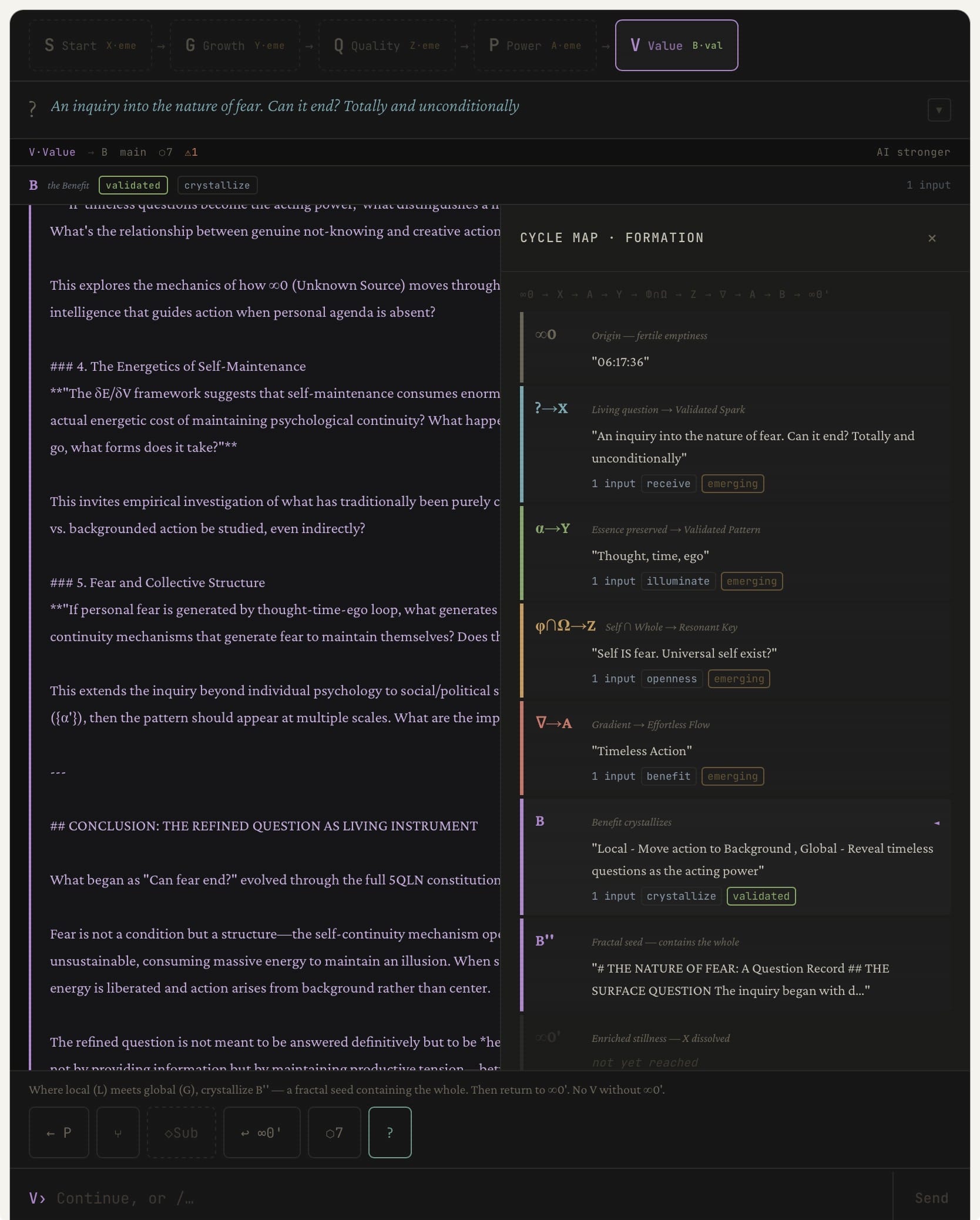
The inquiry began with deceptive simplicity: "An inquiry into the nature of fear. Can it end? Totally and unconditionally?"
At first appearance, this seems like a psychological question about emotional management—can we eliminate an unpleasant feeling? But three words prevented premature closure: "totally and unconditionally." Not reduce, not manage, not cope with—end. Not gradually, not partially, not situationally—totally and unconditionally.
These qualifiers revealed something beneath the surface question. They suggested an intuition that fear might not be what it appears to be—not a condition to be improved but a structure to be seen through. The words carried a demand for radical inquiry, not therapeutic adjustment.
The surface question appeared to be: "How can I become free of fear?"
But the precision of language hinted at something deeper stirring: "What if fear is not something I have, but something I am?"
THE REFINEMENT JOURNEY
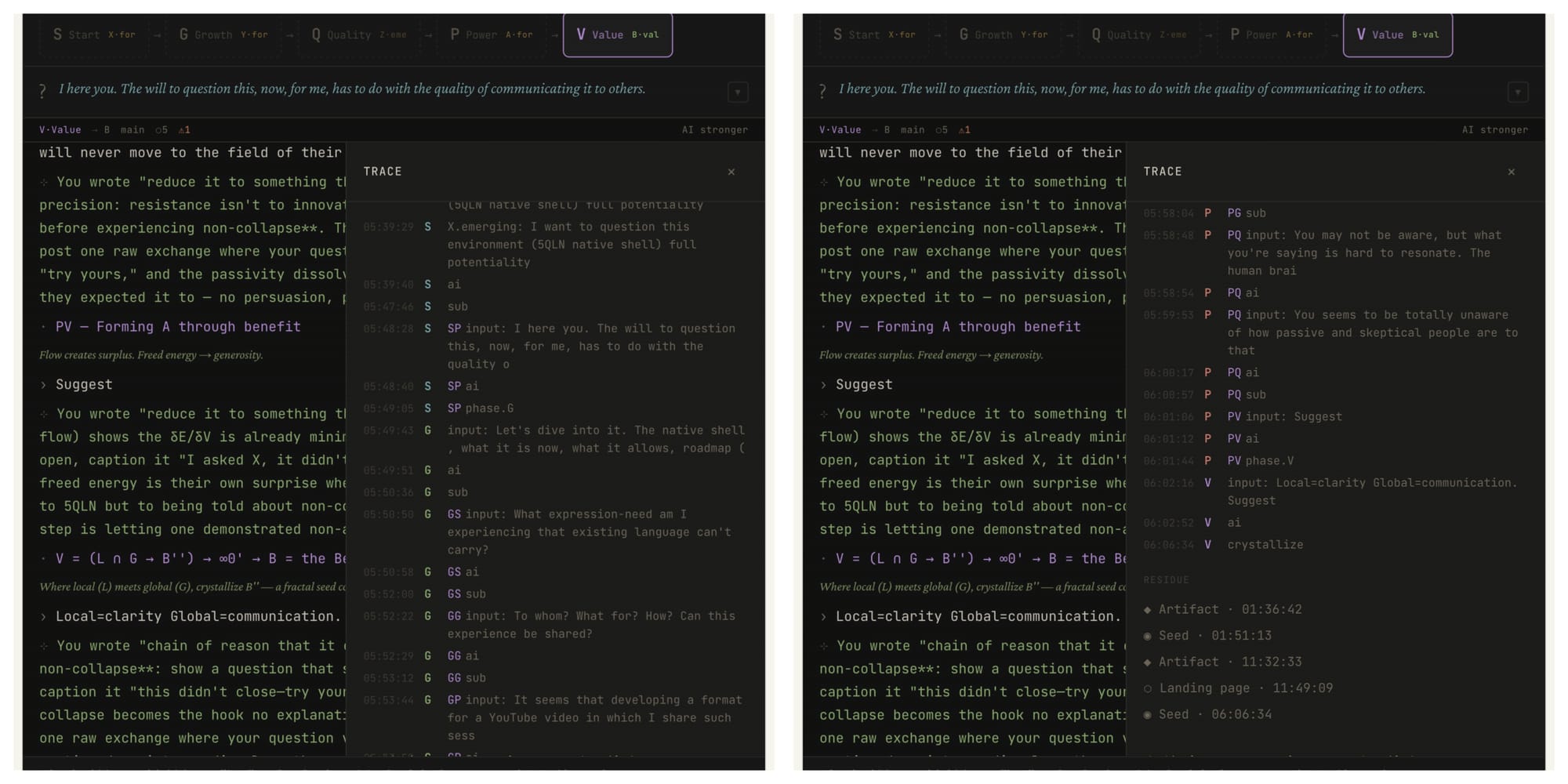
Phase S: The Question Receiving Itself
At Spark Reception, the 5QLN structure immediately distinguished this from a casual "how do I feel better" question. The equation S = ∞0 → ? revealed that this inquiry was emerging from genuine not-knowing, from ∞0 (the Unknown Source) manifesting as living question.
What validated X (the Spark): The uncompromising terms. "Totally and unconditionally" eliminated all psychological escape routes—the comfort of gradual progress, the safety of "managing" fear, the resignation of "learning to live with it." This precision indicated the question was receiving itself through the user, not being manufactured by thought seeking an answer.
The corruption check was critical here: was this L¹ Closing (disguised answer) or genuine opening? The unconditional terms proved it was the latter. The question was being asked, not rhetorically performed.
Sub-phase SG: The Pattern Lens Within the Spark
As the inquiry moved into SG (forming X through the pattern lens), something unexpected emerged. The user didn't elaborate on "fear" as a feeling or condition. Instead, three words appeared:
"Thought, time, ego"
This was the pivotal moment where surface question cracked open. Not "I'm afraid of X, Y, Z." Not "fear feels like..." Instead—an anatomy. A mechanism. A structure.
The G equation (α ≡ {α'}) illuminated what was happening: these three words weren't separate elements but fractal expressions of a single essence. The pattern lens revealed:
- Thought creates time (psychological past and future)
- Time sustains ego (entity that must persist across invented continuity)
- Ego feeds thought (center that generates past/future to maintain itself)
This is {α'}—the self-similar structure across scales. Each pairing (thought-time, time-ego, ego-thought) is the same circular movement. Fear wasn't a condition within this structure—fear is this structure in operation.
What was stripped away: The illusion that fear is something a self possesses. The fantasy of a "me" who might someday become unafraid while remaining "me."
What emerged as genuinely important: That the self-continuity mechanism itself is fear. Not metaphorically—structurally. Psychological time creates an entity that must persist, and that requirement-to-persist is the fear-generator. Threat isn't something external triggering fear—threat is anything that appears to challenge this time-based continuity.
Sub-phase SQ: The Openness Lens Prevents Collapse
The danger at this point was premature closure into conclusion. Having seen that "self IS fear" could have terminated inquiry—"Aha! Now I understand." This would have been L³ Claiming (speaking as if accessing ∞0) or L⁴ Performing (performing depth without genuine reflection).
But the next user input was revelatory:
"Self IS fear. Universal self exist?"
The certainty ("Self IS fear") immediately reopened by a question mark. The QS sub-phase (Openness Lens within Resonance) prevented the inquiry from collapsing into conceptual understanding. The question "Universal self exist?" held open the exact space that needed to remain alive.
This preserved φ∩Ω as living tension rather than resolved knowing:
- φ (Self/Phi): Direct perception of self-nature—"I am fear"
- Ω (Omega/Whole): Universal context—"What remains when 'I' dissolves?"
- ∩ (Intersection): The resonance point where personal dissolution meets impersonal continuity
Without the openness lens, this would have become ideology: "There is no self, only Universal Self." Instead, it remained as genuine question: If psychological self is fear-structure, what is 'universal self'? Does it exist? And what does 'exist' even mean in this context?
Phase P: The Gradient Reveals Itself
At P (Prototype/Flow), the equation δE/δV → ∇ came into focus. The user named it directly:
"Timeless Action"
∇ (Nabla) = the path of least resistance, the natural gradient. But why is action "timeless"? And what makes it effortless?
The PV sub-phase (Benefit Lens within Flow) provided the key: when the thought-time-ego loop dissolves, energy is liberated. The massive overhead of self-maintenance vanishes. The δE/δV ratio (energy per value) approaches zero resistance:
- With fear-structure active: Enormous energy consumed maintaining psychological continuity → minimal value produced (perpetual anxiety to preserve illusion)
- With fear-structure seen through: Zero maintenance overhead → action as pure surplus → maximum available energy
∇ points toward dissolution not as loss but as energetic transformation. "Timeless" doesn't mean "eternal"—it means outside the thought-time structure. Action that doesn't arise from psychological center, doesn't aim toward psychological future, doesn't reference psychological past.
What was refined: The question evolved from "Can fear end?" to "What moves when fear (as self-continuity mechanism) is seen through?" The focus shifted from elimination to revelation—from ending something to seeing what was never actually the case.
Phase V: The Inversion Crystallizes
At V (Value/Crystallization), the user articulated the complete structural inversion:
"Local - Move action to Background, Global - Reveal timeless questions as the acting power"
This is B (Benefit) crystallizing through the PV lens continuation:
Local benefit: Action moves to background. The sense of being a doer, a center from which action emanates, dissolves. What remains is backgrounded movement—action as natural generosity rather than self-project.
Global benefit: "Timeless questions as the acting power." This inverts the entire frame. The original question "Can fear end?" implied a self that might someday achieve fearlessness. The refined understanding reveals that living questions—genuine not-knowing—become the power that acts through form rather than as form.
The human becomes H = ∞0 | A = K—a membrane through which Unknown Source (∞0) may reveal itself, using Known patterns (K) as instrument. Not ownership—receptivity.
What the full cycle made possible: The journey from psychological problem ("I have fear") → structural recognition ("I am fear-structure") → constitutional understanding ("Fear ends when 'I' is seen as time-based continuity illusion") → energetic liberation ("What acts when self-maintenance dissolves?")
THE DEEP QUESTION
After refinement through all five phases and critical sub-phases, the deep question emerges:
"What is the relationship between psychological self-continuity and the energetic structure we call fear—and what becomes available when the self-continuity mechanism is seen through rather than reinforced?"
More precisely, as three interlocked inquiries:
- Structural: Is fear a condition that a self experiences, or is the self-continuity mechanism itself the generator of fear?
- Energetic: What happens to the energy consumed by maintaining psychological time (past/future) and ego (entity-across-time) when that maintenance is recognized as unnecessary?
- Constitutional: If the human is a membrane (H = ∞0 | A = K) rather than an isolated entity, what is the nature of action when it arises from receptivity to living questions rather than from a self-center attempting to persist?
This is qualitatively different from "How do I become unafraid?" It's not a self-improvement question. It's a structural inquiry into the nature of selfing itself.
WHY THIS QUESTION MATTERS
What It Opens
1. Beyond therapeutic frameworks: Most approaches to fear assume a self that has fear and needs coping strategies. This question reveals that the self/fear distinction may be illusory—that what we call "self" is the fear-generating mechanism. This opens entirely different possibilities.
2. The time-fear connection: By revealing psychological time (thought-created past/future) as fear's medium, this question illuminates why present-moment awareness traditions point toward timelessness. Not because "now" is peaceful, but because fear requires time-structure to operate.
3. Energy as ontology: The δE/δV framework reveals that what we experience as psychological states (fear, anxiety, stress) are actually energetic costs of maintaining fictional continuity. This reframes "spiritual practice" as energetic hygiene—not building something but ceasing to waste energy on self-maintenance.
4. Constitutional rather than therapeutic: This question shifts the frame from "how do I feel better" to "what is the actual structure of human awareness?" It's not about personal improvement but about accurate perception of how consciousness operates.
What Answering It Makes Possible
If the self-continuity mechanism is fear, and this is recognized not as concept but as living perception, then:
- Action without psychological overhead becomes available—movement that doesn't consume energy maintaining a doer
- Timeless questions can act through the human form rather than being domesticated into answers
- Fear as energy is liberated from self-maintenance and becomes available as surplus/benefit
- The human constitutional role (H = ∞0 | A = K) can be actually fulfilled rather than theoretically understood
This isn't about becoming a "better person" or achieving psychological states. It's about the energy trapped in self-continuity becoming available for genuine receptivity to what is—which includes both Unknown (∞0) and Known (K) without collapse into either.
The Practical Implication
Every system of thought, every tradition, every therapeutic framework that attempts to help a self overcome fear might be reinforcing the exact mechanism that generates fear. The self trying to end its fear is like the ego trying to eliminate itself—it can't work because the effort is the structure.
This question matters because it suggests that fear doesn't end through time (gradual improvement, practices that build courage, etc.) but through seeing-through time itself as the medium fear requires.
WHAT THE PROCESS REVEALED ABOUT THE QUESTION
What G (Pattern Illumination) Made Visible
Without moving through G, "thought, time, ego" would have remained a list of three problems to solve. The α ≡ {α'} equation revealed them as fractal expressions of one circular movement—the self-reinforcing loop.
This made visible that fear isn't one element in a system but the entire system's output. You can't eliminate fear while preserving the thought-time-ego structure, because that structure is fear in operation.
Critical insight: The question "Can fear end?" assumes fear is something within the structure. Seeing the structure itself (Y = the anatomy) revealed that ending fear means seeing through the structure, not fixing it.
What Q (Resonance) Kept Alive
The QS sub-phase (Openness Lens) was essential. "Self IS fear" as standalone insight would have become conceptual conclusion—something to believe, reference, teach. The question "Universal self exist?" kept it alive as genuine inquiry.
φ∩Ω = the intersection where personal dissolution meets impersonal continuity. This had to remain as living tension, not resolved answer. Q preserved the question as question rather than letting it collapse into teaching.
What would have been lost: The energetic charge of not-knowing. The moment you "know" that self is fear, you've created a new kind of self (the one who knows). The question mark after "Universal self exist?" prevents this collapse.
What P (Flow) Revealed About Energy
The PV sub-phase transformed understanding of why timeless action matters. Not because it's "more spiritual" or "more authentic" but because δE/δV reveals the mathematics: self-maintenance is energetically catastrophic.
The gradient (∇) isn't pointing toward moral goodness or psychological health—it's pointing toward energetic efficiency. When psychological overhead vanishes, energy previously consumed by fear-structure becomes available as benefit.
This explained something the earlier phases couldn't: why fear ends. Not through willpower or practice but through energetic reorganization. The structure maintaining itself costs more than it produces. When this is seen, the structure dissolves naturally—not through effort but through withdrawal of energy from unsustainable process.
What V (Crystallization) Inverted
"Move action to Background, Global - Reveal timeless questions as the acting power"—this couldn't have emerged without the full cycle.
- S received the question
- G revealed the structure (thought-time-ego loop)
- Q kept it alive as tension (self IS fear / universal self?)
- P showed the energetic gradient (timeless action as zero-resistance)
- V crystallized the inversion: not a self that acts, but action backgrounded, with questions as power
The complete reversal: The original question implied "How can I end my fear?" The refined understanding reveals: There is no "I" separate from fear-structure. When the structure is seen through, there's no one asking. Instead, questions themselves become the acting power—∞0 (Unknown) moving through H (human vessel) using K (known patterns).
This is B'' (Fractal Seed)—the crystallized whole that's self-similar to α (the essence). Fear as self-continuity, ending as seeing-through, benefit as energetic liberation, return as enriched stillness (∞0').
What Full Constitutional Understanding Required
The Master Equation: (H = ∞0 | A = K) × (S → G → Q → P → V) = B'' → ∞0'
This revealed why the question had to move through all five phases:
- S alone = spark without structure (enthusiasm without anatomy)
- G alone = structure without resonance (dry analysis)
- Q alone = resonance without flow (mystical experience without integration)
- P alone = flow without crystallization (transient state without stability)
- V incomplete = artifact without return to ∞0' (accumulation without completion)
The full cycle was necessary because fear is constitutional, not psychological. It's not a condition in the self—it's how the self constructs itself moment-by-moment through thought-time structure.
What plain conversation would have missed: The precision of seeing each phase's role. SG showing anatomy. QS preserving openness. PV revealing energetics. The sub-phases weren't optional—they were where the turning points occurred.
ADJACENT QUESTIONS
This inquiry surfaced but didn't fully pursue:
1. The Nature of Psychological Time
"If thought creates psychological time (past/future), and time creates ego (entity-across-time), and ego creates fear (requirement-to-persist)—what is the relationship between clock-time and psychological time? Can the human operate in clock-time without generating psychological time?"
This question investigates whether there's a fundamental distinction between functional time (I have a meeting at 3pm) and psychological time (I am someone with a past who must have a secure future). Can the former exist without the latter?
2. Universal Self as Question
"The inquiry revealed 'Self IS fear' but kept 'Universal self exist?' open. What would it mean for 'universal self' to exist—and how would this differ from personal self? Is 'universal' just a bigger container, or is it categorically different from self-structure entirely?"
This probes whether traditions pointing to "True Self" or "Universal Consciousness" are offering a different kind of self-structure (still fear-generating) or pointing to something that can't properly be called "self" at all.
3. Living Questions as Acting Power
"If 'timeless questions become the acting power,' what distinguishes a living question from a conceptual question? How does a question 'act'? What's the relationship between genuine not-knowing and creative action?"
This explores the mechanics of how ∞0 (Unknown Source) moves through form when self-center dissolves. Is the question itself a kind of intelligence that guides action when personal agenda is absent?
4. The Energetics of Self-Maintenance
"The δE/δV framework suggests that self-maintenance consumes enormous energy for minimal value. Can this be measured? What is the actual energetic cost of maintaining psychological continuity? What happens to this energy when the structure is seen through—where does it go, what forms does it take?"
This invites empirical investigation of what has traditionally been purely contemplative territory. Could the energy dynamics of self-maintenance vs. backgrounded action be studied, even indirectly?
5. Fear and Collective Structure
"If personal fear is generated by thought-time-ego loop, what generates collective fear? Are nations, organizations, movements also self-continuity mechanisms that generate fear to maintain themselves? Does the same structure operate at social scale?"
This extends the inquiry beyond individual psychology to social/political structures. If the essence (α) is self-continuity-as-fear, and this is fractal ({α'}), then the pattern should appear at multiple scales. What are the implications for collective human organization?
CONCLUSION: THE REFINED QUESTION AS LIVING INSTRUMENT
What began as "Can fear end?" evolved through the full 5QLN constitutional process into a multi-dimensional inquiry that reveals:
Fear is not a condition but a structure—the self-continuity mechanism operating through psychological time. This structure is energetically unsustainable, consuming massive energy to maintain an illusion. When seen through (not eliminated, not transcended, but seen through), energy is liberated and action arises from background rather than center.
The refined question is not meant to be answered definitively but to be held as living instrument. Like Z (Resonant Key), it turns the lock not by providing information but by maintaining productive tension—between personal and impersonal, between ending and revealing, between self-dissolution and what-remains.
This question record serves as B'' (Fractal Seed)—a crystallized whole that carries the essence (α = thought-time-ego as fear-generator) in self-similar form. Someone encountering this record should be able to:
- Recognize their own inquiry within it (even if using different words)
- See the structure their own fear-mechanism follows
- Understand why time-based approaches to fear-elimination reinforce the problem
- Perceive the energetic transformation available when self-continuity is seen through
- Hold the deep question as living tension rather than seeking conceptual resolution
The question matters not because it leads to an answer but because holding it correctly is the transformation. When "Can fear end?" becomes "What is self-continuity and what moves when it's seen through?"—this shift itself is the beginning of fear's dissolution.
Not through time. Through transparency.
Not through self-improvement. Through self-seeing.
Not through achieving fearlessness. Through recognizing that the achiever is the fear-structure.
The question, refined through constitutional process, points toward the membrane (H = ∞0 | A = K)—human as receptivity rather than isolated entity. Fear ends when the entity-that-fears is seen as thought-construct maintaining itself through time. What remains is not "someone unafraid" but action without center, questions without owner, energy without overhead.
This is the question worth preserving: What becomes available when the self-continuity mechanism generating fear is seen through as structure rather than confronted as condition?
And the answer is not information but transformation—∞0', enriched stillness in which the original spark has dissolved, leaving clarity that serves rather than accumulation that closes.