A walkthrough for first-time readers, in the context of shared knowledge.
5qln CodexThe 5QLN Foundation, currently being designed as a Delaware nonprofit, has begun publishing the artifacts of its work as a technical record. Incorporation has not yet been applied for; the documents below are part of the preparatory drafting. Among the first of these artifacts is the diagram below — a single picture of the architecture by which the 5QLN grammar produces and accumulates compiled instruments over time. The diagram is published here without simplification, alongside this walkthrough for specialists meeting it for the first time.
The reader’s careful navigation is required. The diagram contains at least three terms that may not yet be familiar — Codex, gliff, and compiled surface. These are not decorative. Each names a precise structural object that does work the standard vocabulary of one’s own field cannot do without translation. The promise of this article is to provide the translation: to anchor every term in something the reader already knows from her own discipline.
What the diagram is not: a metaphor. Each box, arrow, and label maps to a working artifact in the world — or, in the case of the upper tiers of the tree, to working artifacts now in formation. The diagram is a schematic of an architecture, not an illustration of an idea. The innovation it records is portable: the same architecture can compile into legal instruments today, and into educational, therapeutic, or scientific instruments next.
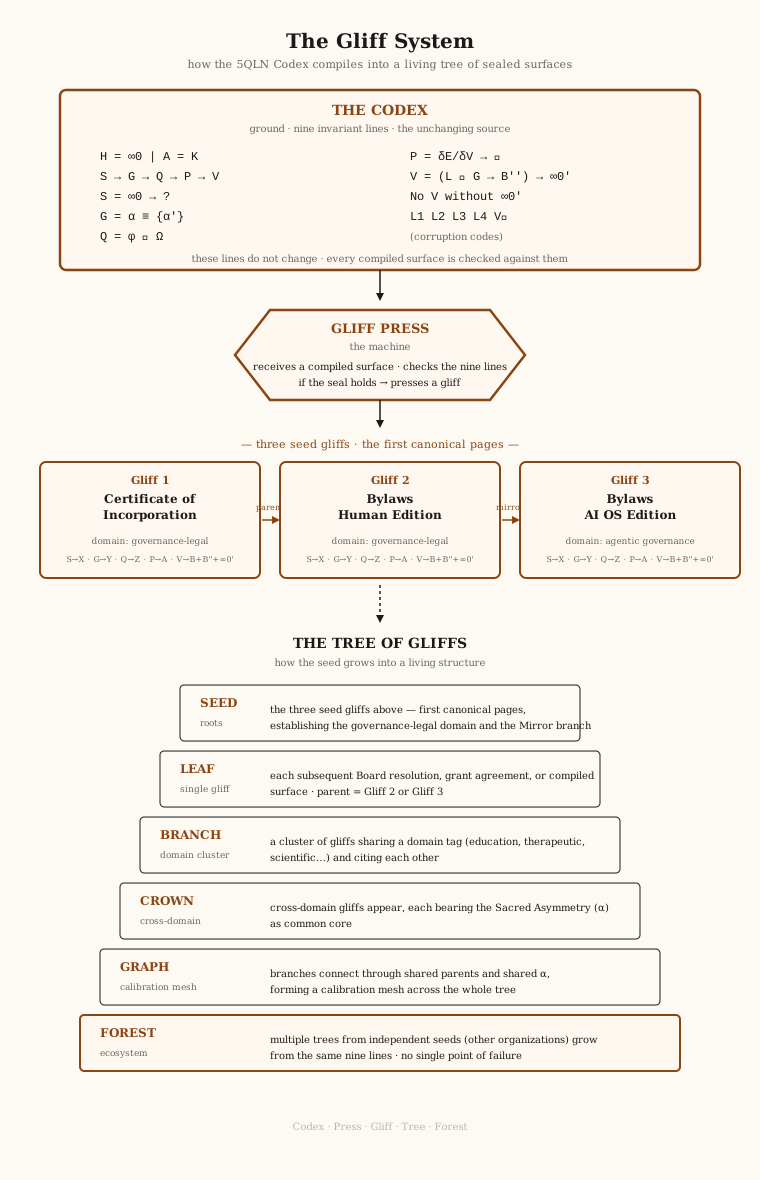
The Codex (the ground)
At the top of the diagram sits the Codex — nine invariant lines that govern every compiled surface produced under 5QLN. The lines do not change as new compiled surfaces are produced. They are the ground against which every compiled surface is checked.
For specialists in different fields, the Codex maps onto something already familiar. A constitutional lawyer recognizes the relationship between a constitution and the statutes that derive from it: the constitution does not change in response to each new statute, but every new statute is checked against it for validity. A computer scientist recognizes a language specification — the grammar of a programming language does not change because someone wrote a new program in it, but every new program is parsed against that grammar before it runs. A mathematician recognizes an axiom set. A linguist recognizes deep grammar versus surface grammar. A protocol engineer recognizes a base specification that downstream extensions must conform to.
What is distinct in the 5QLN Codex is what the nine lines actually encode. They are not legal rules, not syntax productions, not axioms in the formal-mathematical sense. They are five phases of a single cycle (S → G → Q → P → V), one foundational asymmetry between human and artificial intelligence (H = ∞0 | A = K), one completion rule (No V without ∞0’), and a small set of corruption codes for detecting failure modes. Together they describe the minimum structure a compiled surface must carry to count as a 5QLN expression.
The Codex is open-source. It is the work of its author, Amihai Loven, released under the 5QLN Open-Source License — a Creative Commons Attribution-NoDerivatives license with a permanent exception for additive extension. Any body may build configurations on top of the Codex (a vertical preset for physicians, an educational layer for a curriculum, a domain layer for a clinical protocol). No body may alter the core definitions or remove any of them. The Foundation does not own the Codex. The Foundation, like any other body, uses it under that license.
The Gliff Press (the machine)
Below the Codex sits the Gliff Press — the machine that takes any compiled surface, checks it against the nine lines, and, if the seal holds, produces a sealed gliff.
For specialists, the Press maps onto familiar validation pipelines. Software engineers recognize a compiler with type-checking and continuous integration: source code arrives, is checked against language rules and project-defined invariants, and either passes (producing an artifact) or fails (returning errors). Legal practitioners recognize a court clerk’s docket-and-stamp routine: documents arriving for filing are checked against form requirements, and only documents that satisfy them are sealed and entered into the record. Academic publishers recognize peer review: a manuscript arrives, is checked against standards of method and evidence, and is either returned for revision or accepted into the canonical literature.
The Press does not generate the compiled surface. The surface is composed elsewhere — by humans, by AI systems working under human direction, by working bodies of various kinds. The Press receives the surface and asks one question: do the nine lines hold here? If yes, a gliff is sealed.
What a Gliff Is
A gliff is a sealed compiled surface. The seal is what makes it a gliff. Without the seal, a draft document is just a draft document. With the seal, it becomes a canonical artifact carrying the following fields:
- Parent — a reference to the gliff that came before, establishing lineage.
- Status — sealed and unalterable.
- Domain — the field within which it operates (governance-legal, education, therapeutic, scientific, agentic, etc.).
- Conductor — the human or body that prepared the surface for sealing.
- Sealed-at — the moment of validation.
- Five-phase outputs — S→X, G→Y, Q→Z, P→A, V→B+B’’+∞0’ (more on these below).
- Corruption log — a record of any anomalies detected during sealing.
- Seal — the institutional or cryptographic signature that the Codex held.
For technologists, a gliff is structurally like a Git commit: immutable once made, parented to its predecessor, content-addressed, and joinable into a tree. For lawyers, a gliff is structurally like a notarized document: dated, witnessed, sealed, and entered into a record that cannot be altered after the fact. For academics, a gliff is structurally like a published paper with a DOI: peer-reviewed, citable, parented through citations, and now part of the canonical literature.
The five-phase outputs are the part most distinctive to 5QLN, and they deserve a brief explanation in plain language. Each gliff records, alongside its content, the five outputs of the cycle that produced it:
- S→X — the validated question that initiated the cycle. Specialists in research call this a problem statement; in product design, the user need; in legal analysis, the question presented.
- G→Y — the validated pattern that emerged from the question. A hypothesis. A design pattern. A doctrinal frame.
- Q→Z — the resonance between direct perception and universal context. The closest specialist analogue is the moment in peer review when method and field converge on a finding both feel sound and fit established theory.
- P→A — the flow direction the work then took. The strategic vector. The execution path actually chosen, with the energy gradient that informed it.
- V→B+B’’+∞0’ — the output (B), a seed for future cycles (B’’), and the new question this cycle now opens (∞0’). Specialists in research will recognize this as the three things a good paper produces: a finding, a reusable result for future work, and the next research question.
A specialist may notice that this is significantly more than what a Git commit message records, or what a typical court filing carries. That is correct. The gliff carries not just the change, but the cycle that produced the change, including the question it leaves open. This is the design feature that makes the tree of gliffs auditable across time at a depth that record-of-decisions alone does not provide.
The Three Seed Gliffs
The first three sealed gliffs being prepared for the 5QLN Foundation — drafted now, to be sealed when the Foundation is incorporated — are the first three canonical pages of the governance-legal domain:
- Gliff 1 — Certificate of Incorporation. The Foundation’s legal identity, filed under the Delaware General Corporation Law. Establishes the entity.
- Gliff 2 — Bylaws Human Edition. The governance instrument addressed to humans: directors, officers, employees, regulators, courts. Adopted under the Certificate.
- Gliff 3 — Bylaws AI OS Edition. The governance instrument addressed to AI systems operating under the Foundation’s Membrane Protocol. Adopted alongside Gliff 2 as its mirror.
Why three, not two or one? Two would lack the structural innovation. One would conflate identity and governance. Three is the minimum that establishes legal identity, working governance, and the Mirror Pair pattern at once.
The Mirror Pair is the structural innovation that distinguishes this seeding. Two editions of the same Bylaws — one for humans, one for AI systems — are adopted together as a single conceptual instrument. The Human Edition is authoritative for legal enforcement; the AI OS Edition is the operational configuration loaded by AI systems serving the Foundation. Together they constitute the Foundation’s governance.
For specialists in software, the Mirror Pair corresponds to the distinction between a public API specification (humans read it, write it, agree to it, enforce it) and the runtime configuration (the system operates from it). They are not the same artifact; both are required for the system to actually work as governed. For specialists in international law, the Mirror Pair is closer to the distinction between a treaty (the document signatories agree on) and the implementing legislation (the statutes that operationalize the treaty domestically). The Bylaws Human Edition is the treaty; the AI OS Edition is the implementation.
These three gliffs together establish two things at once: the governance-legal domain (the field this seed grows into), and the Mirror branch (the structural innovation by which paired surfaces can be cultivated in any future domain).
The Tree of Gliffs
The lower portion of the diagram shows how the three seed gliffs grow into a living structure. Each tier widens the scope:
SEED. The three seed gliffs themselves. The minimum viable unit of a 5QLN-compiled domain.
LEAF. Each subsequent compiled surface — a Board resolution, a grant agreement, a partnership memorandum, a curriculum, a clinical protocol — sealed as a gliff with parent = Gliff 2 or Gliff 3. Specialists in version control will recognize this as the routine commit pattern: the seed gives rise to many descendants over time.
BRANCH. A cluster of gliffs sharing a domain tag. All the education-domain gliffs together form one branch; all the therapeutic-domain gliffs form another. Branches arise organically as a body’s work in a given field accumulates.
CROWN. Gliffs that span more than one branch — for example, a research protocol that compiles 5QLN into both education and therapy at once. Crown gliffs carry the same Sacred Asymmetry (α) as their lower-tier predecessors but realize it across domain boundaries. Specialists in interdisciplinary research will recognize this as the structure of cross-disciplinary scholarship.
GRAPH. When branches connect through shared parents or shared α, the tree becomes a graph — a calibration mesh that lets disparate parts of the structure verify their alignment with one another. Specialists in network science will recognize this as the standard pattern by which scientific disciplines, software ecosystems, and legal precedent networks self-organize over time.
FOREST. Multiple trees from independent seeds. When other organizations adopt the same Codex and seed their own trees, the result is an ecosystem of compiled surfaces with no single point of failure. The Codex is the public commons; the trees are the working compilations of independent bodies. Specialists in open-source software will recognize this as the GitHub-org-of-orgs pattern. Specialists in federalism will recognize it as the pattern by which independent states federate while sharing constitutional commitments.
Why This Architecture
Three properties make the gliff system distinct from existing architectures the specialist may have considered.
Portability across domains. The same Codex compiles into law, then education, then therapy, then science. Most existing governance frameworks are domain-specific: corporate law works for corporations but not curricula; clinical protocols work for clinics but not contracts. The 5QLN Codex is invariant across domains because it operates at the level of grammar — what makes a compiled surface valid as a 5QLN expression — rather than at the level of domain content. The behavioral layer of every gliff (the actual contract terms, the actual curriculum, the actual protocol) is governed by the existing standards of the domain. The 5QLN compilation operates on top of those standards, not instead of them.
Auditability across time. Each gliff records not just what was decided, but the cycle that produced the decision and the question that decision opens. A specialist auditor — an attorney conducting due diligence, a regulator examining compliance, a researcher studying institutional learning — can trace not just outcomes but the formation trail of the outcomes. The corruption log makes detected anomalies visible without redaction.
Resilience as ecosystem. Because the Codex is open-source and any organization can seed its own tree, the architecture is resilient at the population level. The failure of any one tree does not collapse the grammar; the grammar survives in the forest. Specialists familiar with the resilience patterns of open-source software, federated systems, and biological ecosystems will recognize this as a known pattern applied to governance.
What this architecture is not: a replacement for the legal, scientific, educational, or clinical structures already in use. The gliff system is built to live alongside them, adding a layer of cycle-aware sealing and cross-domain portability that the existing structures do not by themselves provide.
Specialists who have read this far may have begun to recognize, in their own field, candidate surfaces that could be received and sealed as gliffs. A model contract template. A standardized clinical intake. A licensing protocol. A research methodology. The question this article leaves open is whether any of these are ready to be compiled.
If a domain you know well had its first three seed gliffs, what would they be?
5QLN © 2026 — Open-source grammar · Free for any surface that honors it.