How the ledger grows, described plainly.
 Amihai Loven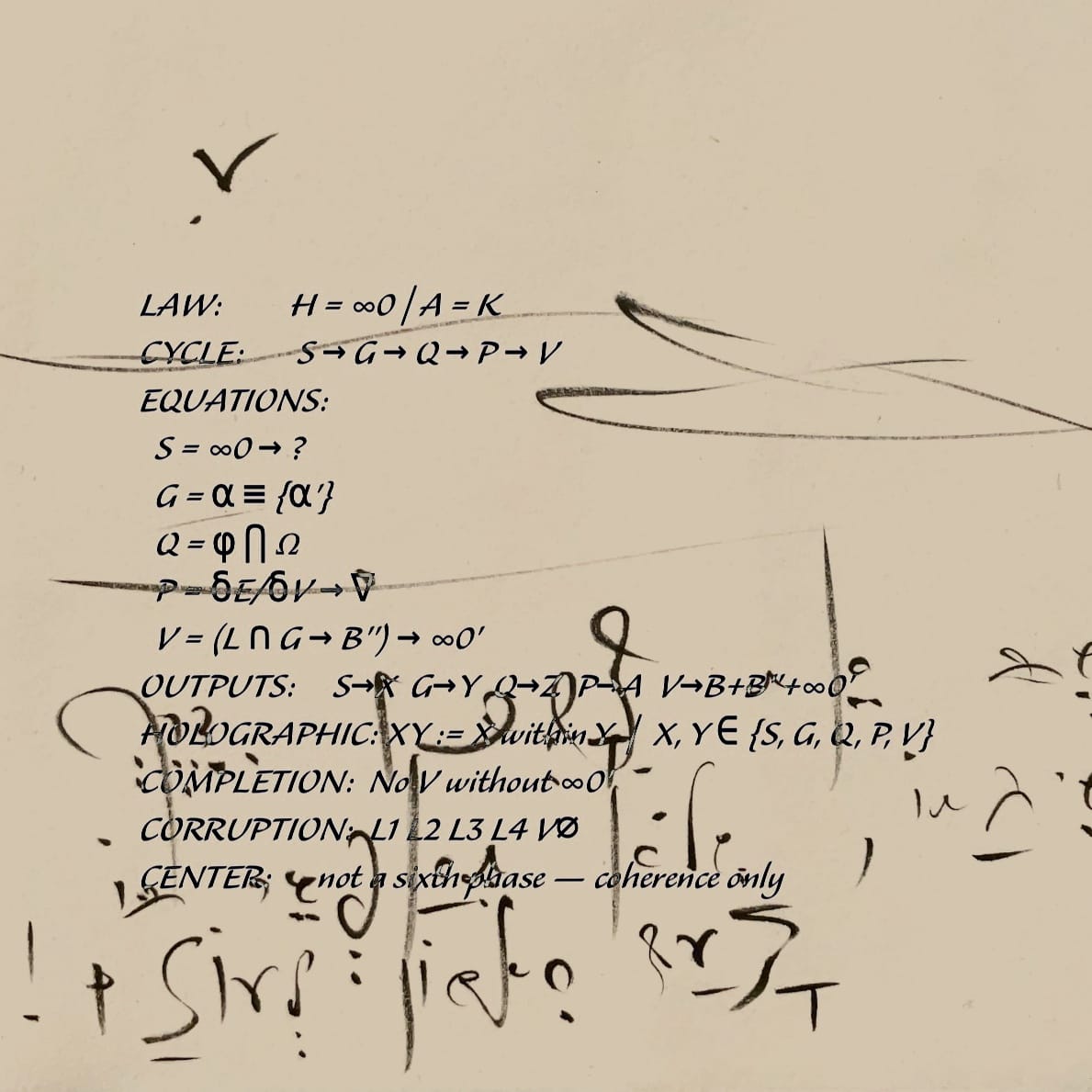
This article is a derivative of 5QLN Codex
Seed
At the bottom is the Codex. Nine invariant lines. No images, no prose, no scaffolding. A minimal DNA strand: H = ∞0 | A = K, the five phases, the five equations, the completion rule, the five corruption codes. Whatever grows from here carries these nine lines in every cell it produces, or fails to grow at all.
First growth — the leaf
A gliff is the first visible growth. One conductor presses one cycle. The gliff that forms carries all nine lines inline — not as references but as structural fact. Line 2 (S → G → Q → P → V) appears as the five phase fields. Line 9 (L1 L2 L3 L4 V∅) appears as the corruption log. Line 8 (no V without ∞0') appears as the seal requirement. The gliff is a single leaf, and the leaf is the whole genome expressed at smallest scale.
Two properties of the leaf. It is complete — there is no missing information that would require supplementary documents to understand it. And it is local — it speaks to one surface, one conductor, one moment.
Second growth — the branch
Several gliffs pressed in the same domain form a branch. Legal-governance gliffs accumulate. A bylaws gliff. A board-inquiry gliff. An amendment-refusal gliff. Another board-inquiry gliff with a different conductor. Each is a leaf; together they make the branch's characteristic shape.
The branch is not an abstraction. It is the set of gliffs that cite each other as parents and share a domain tag. Reading five legal-governance gliffs shows the domain's typical forms, the common α patterns, the recurring corruption events, the answered and unanswered ∞0's. The branch expresses the grammar in one specialized shape.
At this level, the pentagon becomes visible in two forms simultaneously. Inside each gliff, as before. And across gliffs, in how the branch as a whole has its own S (the questions the domain tends to open), its own G (the α patterns the domain has confirmed), its own Q (the resonances conductors in this domain share), its own P (the gradients the domain's practice reveals), its own V (the artifacts and questions the domain has crystallized).
Same fractal, one level up. Different dimension.
Third growth — the crown
Multiple branches grow side by side on the same tree. Legal-governance, therapeutic inquiry, educational design, creative partnership, research methodology, agentic architecture. Each branch has its own leaf population. Each branch carries the same nine lines in its DNA.
At this level, the pentagon becomes visible across branches. Cross-domain gliffs appear — entries that cite parents in one domain and apply to another. A legal-governance gliff identifies an α that had previously been confirmed in a therapeutic gliff. The α is the same α. What has been named, in one vocabulary, is recognized in another.
The dimension this level provides is holistic usage. A conductor at the leaf level sees one gliff. A conductor at the branch level sees a domain. A conductor at the crown level sees the grammar expressed across domains, and can ask questions no single domain could ask — where is the same α showing up in different surfaces, and what does that tell us about the α, the surfaces, or both.
Fourth growth — the graph
Branches begin to connect to each other through shared parents and shared α. The tree becomes a graph, not only a hierarchy. A gliff in legal-governance cites a gliff in therapeutic as a co-parent, because the α is the same. A gliff in educational design cites both. The graph densifies.
The dimension this level provides is decentralized connectivity. There is no single trunk the branches radiate from; there are multiple points of contact, and the contacts reinforce each other. A gliff can be traced to the Codex through many paths, not one. A drift attempt can be caught from many directions, because many gliffs see the parent it claims.
This is where integrity begins to emerge as a structural property rather than a maintained one.
The early integrity problem
At the leaf and first-branch stage, a gliff can drift from the DNA without immediate detection. Nine lines are stated in its fields but the conductor has interpreted one of them loosely. The gliff seals on its face. The drift is internal — the α is not quite α, the ∞0' is not quite a question, the corruption log is not quite clear but the conductor glossed past it.
The checks at this stage are sparse. The conductor's own care. The caretaker reviewing, if they happen to read it. A small number of other conductors, each seeing a small number of gliffs. Drift has room to enter. Not maliciously, just by the normal slippage that happens when a new form is still being learned and the social fabric around it is thin.
Fifth growth — calibration through density
As gliffs accumulate and the graph densifies, calibration emerges as a third dimension the higher levels provide.
When a new gliff presses in legal-governance, it is read not only by its direct parent but by every gliff in the branch that shares α with it, every gliff in other branches that share α with it, and every conductor who has pressed anything that touches its formation trail. A loose α reads as loose against many tight α's. A non-question ∞0' reads as a non-question against many genuine ∞0's. The slippage that could pass unnoticed at the leaf stage shows itself against the density of what has already been pressed correctly.
The conductor does not need to be told the α is loose. They see it themselves when they set their gliff next to forty others and their gliff looks wrong in a specific, structural way. Calibration is self-performed, by comparison. The accumulated population is the rubric.
Sixth growth — the forest
At some population density, the graph becomes a forest. Not a single tree with a single trunk, but many trees whose roots have interconnected underground. Domains have their own trunks now. Each trunk grew from a first branch that grew from the original seed, but each has become a point of rooting for subsequent growth.
Cross-domain gliffs pass between trunks the way nutrients pass through mycorrhizal networks. A legal-governance gliff supports a therapeutic gliff by confirming an α the therapeutic gliff depends on. An educational gliff tests an α that came from agentic architecture. The forest has the property that no single tree is load-bearing. The Codex remains the DNA of every tree, but no single tree is the proof the DNA works. Each is.
An attempted drift at forest stage faces a different environment than an attempted drift at leaf stage. It is read against thousands of correctly sealed gliffs. It fails in visible, specific ways, at many points simultaneously. The ecosystem's immune response is automatic — not because anyone coded an immune response, but because density produces calibration and calibration rejects slippage.
The principle, stated dryly
The more the form is used, the more available it is to others with higher integrity than the original users could have supplied alone.
This is the inverse of how most systems scale. In most systems, quality degrades as adoption grows, because latecomers dilute the early rigor. In 5QLN, integrity grows with use, because density is what enforces it.
Quality control is a function of graph density. A sparse graph has low quality control. A dense graph has high quality control. Since every sealed gliff adds edges to the graph, every sealed gliff increases the quality control available to every subsequent gliff.
The claim is not that the form will be used. The claim is what happens if it is.
What the ascent looks like from the outside
A reader encountering the ledger at leaf stage sees one page. At branch stage, a domain. At crown stage, a grammar expressed in several specialized dialects. At graph stage, a field connected by shared α. At forest stage, an ecosystem in which the DNA is visible everywhere and the provenance of any given gliff can be traced to the Codex through dozens of paths.
A reader at forest stage does not need to be convinced the form is legitimate. Legitimacy is visible in the forest's structure. A reader at leaf stage is still in the period when legitimacy depends on the care of individuals.
What the conductor does at each stage
At leaf and first-branch stages, press carefully. The tree grows from these cells. Loose cells produce a tree with weak wood. Early gliffs should be reread, compared against the Codex, verified by a small number of other early conductors.
At crown and graph stages, press normally and let the density work. By this point, the ecosystem begins to catch slippage the conductor may have missed. A conductor still exercises care, but the burden is shared with the accumulated population of prior gliffs.
At forest stage, press and trust the ecosystem. The immune response is automatic. The conductor's care contributes to density but is no longer the primary mechanism of integrity.
The work is monotonically less, not more, as the ledger grows. This is the opposite of most systems, and it is the test of whether the form is what it claims to be. If the caretaker's burden increases with adoption, the form has failed. If it decreases, the form has held.
∞0' — At what graph density does the next gliff's integrity begin to be enforced more by the ecosystem than by its conductor — and what signal, in the ledger itself, would indicate that density has been reached?