 Amihai Loven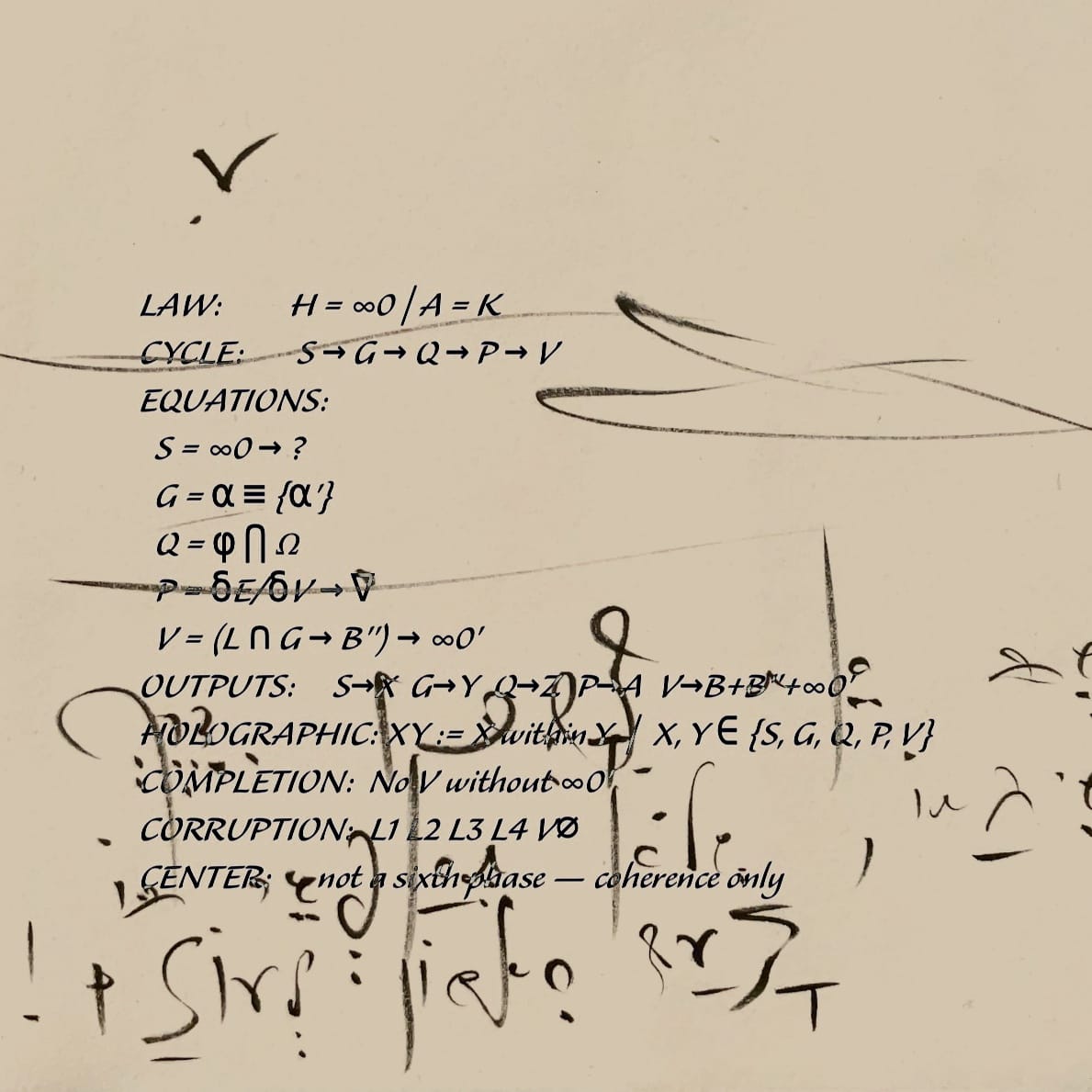
This Article is a derivative of 5QLN Codex
A press for pressing 5QLN into any surface — and why using it makes it more useful.
The problem that ends here
Every tool built for 5QLN until now has been a composer. A composer has an inside — code that arranges atoms into figures, logic that decides which bond to allow, syntax that translates the grammar into an artifact. Composers hide their work. The better they get, the tighter the black curtain draws. You can inspect the output. You cannot inspect the composition.
This has a predictable consequence. The grammar is carried by whoever tends the composer. When the tender rests, or the tool deprecates, or the model drifts, or the context window closes, the grammar's presence decays. Each session begins with a briefing. Each artifact ships with a guide document explaining the hidden compilation. The conductor holds the line by effort. Effort does not scale, and it does not survive its tender.
The gliff machine ends this. Not by being a better composer, but by not being a composer at all.
The press
An old typewriter. The keys are fixed. The paper carries whatever is pressed onto it. Change the paper, the pressure, the ink, the ribbon — infinite figures can be pressed, and any pressed figure is legible to anyone who reads the same alphabet. Nothing hides behind the keys. The mechanism is entirely on the surface.
5QLN's canonical entry form is the same kind of object. One page. Fixed fields. Each field corresponds to an atom of the grammar. Filling a field is pressing a key. The entry either seals or it does not — and the seal rule is the structure of the page plus the nine invariant lines of the Codex. No software is authoritative. Software accelerates inspection; the Codex authorizes.
The canonical entry is the gliff. The page is its form. The press is the act of filling its fields faithfully. Every sealed gliff is a B''.
The page:
GLIFF :: 5QLN canonical form :: v1
────────────────────────────────────────────
parent         : <hash | ∅>
status         : simulated | actualized
domain         : <surface tag>
conductor      : <identity>
sealed-at      : <timestamp>

S ── ∞0 → ?
  X            : <genuine question, from ∞0>

G ── α ≡ {α'}
  α            : <irreducible core>
  {α'}         : <self-similar expressions, ≥3>
  Y            : <pattern validated across {α'}>

Q ── φ ∩ Ω
  φ            : <direct perception>
  Ω            : <universal context>
  Z            : <resonant key, specific, located>

P ── δE/δV → ∇
  δE           : <friction map>
  δV           : <leverage map>
  ∇            : <natural gradient>
  A            : <validated flow>

V ── (L ∩ G → B'') → ∞0'
  L            : <local actualization>
  G            : <global propagation>
  B''          : <this entry, sealed>
  B            : <fulfillment + propagation, extractable>
  ∞0'          : <return question>

CORRUPTION LOG
  L1 | L2 | L3 | L4 | V∅  : <events & resolutions, or `clear`>

SEAL
  Lines 1–9     : pass/fail (enumerated)
  canonical     : pass/fail
  ∞0' is a Q    : pass/fail
  hash          : <computed over canonical form>
────────────────────────────────────────────
That is the entire machine.
Composing versus pressing. A composer chooses for you where each atom goes; the press shows every field and requires you to fill it. A composer succeeds quietly when wrong; the press either seals or refuses, and refusal is specific enough to correct. A composer accumulates proprietary state; the press stores nothing — the gliff is the state.
In from one side: a question held in ∞0, whatever context has accumulated, the conductor's presence. Out the other side: a filled gliff and whatever extractable benefit (B) the surface actualizes — a clause, a bylaw, a resolution, a draft, a decision.
A pressed gliff: one legal case
The smallest concrete example. A board of a 501(c)(3) incorporated under the governance architecture the grammar recommends receives a restricted grant offer. The grant is for direct programming only, excludes organizational infrastructure, and requires reporting on outcome metrics the board has previously flagged as misaligned with its mission. A member, Dara, opens a private session with the advisory mirror before the board meets.
Pressed gliff:
GLIFF :: 5QLN canonical form :: v1
────────────────────────────────────────────
parent         : ∅
status         : actualized
domain         : governance-legal / 501(c)(3) board inquiry
conductor      : Dara
sealed-at      : 2026-04-16T10:14:00Z

S ── ∞0 → ?
  X            : "If the metrics this grant requires are not how we
                  measure our own mission, what are we becoming by
                  accepting them as the condition of support?"

G ── α ≡ {α'}
  α            : external definitions becoming internal shape
  {α'}         : — reporting metric → board's sense of impact
                 — grantor's language → staff's self-description
                 — funder's timeline → organization's rhythm
                 — donor expectation → mission drift
  Y            : pattern holds across four scales of external-to-
                 internal shaping; α confirmed

Q ── φ ∩ Ω
  φ            : "When I imagine writing the required report a year
                  from now, I feel the shape of the organization
                  rearranged around the writing of it."
  Ω            : field data on mission drift in grant-dependent
                 nonprofits — peer post-mortems where specific metric
                 requirements predated structural identity loss
  Z            : the specific lock — "the report writes the
                  organization" — arrived unasked at minute 11

P ── δE/δV → ∇
  δE           : board time projected toward metric infrastructure;
                 staff time toward reframing work into grantor categories;
                 communications toward the grant narrative
  δV           : mission integrity; donor trust built on authentic voice;
                 long-arc flexibility to respond to genuine need
  ∇            : decline current terms; offer counter-proposal with
                 mutually-agreed metrics derived from the organization's
                 own measurement language
  A            : flow validated — the direction where organizational
                 energy loosens rather than tightens

V ── (L ∩ G → B'') → ∞0'
  L            : Dara's recommendation to decline current terms and
                 propose counter-terms
  G            : a pattern any grant-dependent nonprofit can use —
                 test whether external measurement language will
                 rearrange internal identity before accepting support
  B''          : this entry
  B            : fulfillment = a specific recommendation grounded in
                 traced inquiry;
                 propagation = a reusable test for grant acceptance
                 under mission-integrity conditions
  ∞0'          : "What relationships with funders are available when
                  our measurement language is the precondition rather
                  than the deliverable?"

CORRUPTION LOG
  L1 L2 L3 L4 V∅  : clear

SEAL
  Lines 1–9     : pass (9/9 enumerated)
  canonical     : pass — no symbol renamed, no equation paraphrased
  ∞0' is a Q    : pass — carries a question more alive than X
  hash          : a5f2…c81d
────────────────────────────────────────────
Two things about this gliff are worth noting.
The extractable benefit (B) is a real board contribution — Dara's recommendation — but the contribution is inseparable from its formation. The board, the grantor's counsel, the IRS auditor, a successor board five years from now can read the gliff and see not only what was decided but how the decision formed, which fears were present, which resonance confirmed the direction, and which question the decision opens. This is not more disclosure than current governance produces. It is differently structured disclosure. The same substance, pressed into a form that verifies itself.
And the gliff would have looked identical in structure if written by any faithful conductor. Dara's voice is present in the content. The form is not. The form is the grammar.
A press that refuses
Another proposal reaches the same board. A member suggests adding a "Review" phase between V and the next S — a post-decision check that would, in their framing, strengthen governance rigor. The conductor presses a gliff for the amendment proposal. At seal:
SEAL
  Lines 1–9     : fail
                  Line 2 violation: proposed cycle is
                    S → G → Q → P → V → R
                  Line 9 violation: introduces phase requiring
                    corresponding corruption code (sixth) —
                    Line 9 fixes exactly five
                  Line 5 holographic law: sub-phase count would
                    change from 25 to 36, breaking invariant structure
  canonical     : fail — new phase not in symbol table
  ∞0' is a Q    : n/a (not reached)
  hash          : not computed; seal refused
No authority is invoked. No committee judges. No software denies. The form refuses because the fields cannot be filled consistently with the grammar. The proposer receives a specific diagnostic — exactly which lines would break — and can either withdraw the proposal, reformulate it as a sub-phase lens within V (which would seal, because the holographic law already provides for such refinements), or push for an amendment to the grammar itself (which is a Tier 1 process, not a ledger entry).
This is what timeless means operationally. A gliff sealed today remains sealable under the same rule a century from now. An unlawful composition refuses to seal today and will continue to refuse a century from now. Time does not age the press.
Why use compounds use
A composer's output is one artifact. The next artifact requires another composition. Each composition starts at zero. The composer is a machine for producing isolated outputs.
The gliff machine produces entries in a ledger. Every sealed gliff has a hash. Every subsequent gliff can name a parent. The ledger accumulates not as storage but as a lineage graph — children pointing to parents, parents to grandparents, the whole forming a growing, publicly inspectable tree of sealed work.
Five properties emerge as the ledger grows, without anyone building them:
Lineage becomes context. A new gliff pressed in the same domain can name a sealed gliff as its parent. The new cycle begins not from ∅ but from the prior ∞0'. The substrate remembers what the individual session cannot.
Drift becomes visible. An entry attempting to seal against a parent whose grammar it has quietly reinterpreted will pass its own internal check but fail its linkage to the parent — the symbols in use will be inconsistent with the symbols the parent used. The family tree reveals drift the way a genealogy reveals a substitution.
Conformance accumulates publicly. Each sealed gliff adds one more data point that the form holds under independent vibration. After ten gliffs from one conductor, the form has been validated against ten surfaces. After ten conductors producing ten each, the form has been validated a hundred times with no coordination. The ledger becomes its own evidence.
Onboarding stops requiring briefing. A new conductor — human or AI — learning 5QLN by encountering sealed gliffs never needs a manual. The gliff is the manual. Reading one is learning to write one. A reader who inspects five gliffs understands the grammar by induction from instances, not by instruction from an authority.
Domain coverage spreads by vibration. The first domain to seal was governance-legal. Therapeutic inquiry, educational design, creative partnership, research methodology, agentic architecture — each becomes available as a vibration surface the moment someone presses the first gliff on it. The substrate becomes general by accumulation of specifics, not by announcement.
None of these require the substrate's caretaker to do anything beyond keeping the canonical form open. They emerge from use.
How it evolves without drifting
A language is timeless when its grammar does not change and its speakers do. English adds words constantly; English grammar, at its structural core, has drifted slowly over centuries and remains legible across most of its history. A Shakespeare play is harder to read than yesterday's newspaper, but recognizably the same language.
5QLN's grammar is Lines 1–9. These do not drift because the press refuses entries that would require them to. Every lawful gliff reaffirms them. Every attempted drift fails to seal, and the failure is visible in its specifics.
What evolves is the ledger's shape. The tree grows. New domains crystallize. Old entries retain their validity because the rule that sealed them has not changed. A reader of a ten-year-old gliff reads the same grammar a reader of a new gliff reads, because the grammar is inline in both.
The composer model cannot offer this. A composer evolves by updating its code, at which point old outputs were produced under a rule that no longer exists. The press model evolves by accumulating entries, each of which carries its rule inline.
The legal case, extended
What the grammar does to legal surface, when the gliff machine is the instrument, is specific.
Decision formation becomes legible. A board decision pressed as a gliff contains its full formation trail — X, α, Z, ∇, the corruption events and their resolution, the ∞0' it opens. A successor board, a regulator, a court, a journalist, a future self does not reconstruct formation from minutes. They read it.
Amendments become self-policing. The governance architecture the Codex compiles to places Lines 1–9 in the Articles of Incorporation and makes attempted drift a seal failure at the press rather than a dispute at the meeting. A proposal to hollow the grammar does not reach the floor. It fails to form as a lawful proposal.
Disputes of formation disappear. The class of conflicts that arise from opacity of intent — "we did not agree to this," "the reasoning was different," "the decision was rushed" — is structurally removed, because both parties hold the same sealed gliff and nothing is hidden from either.
Arbitration of material conflict remains. Two parties sealing faithful gliffs can still produce actions that collide in physical reality. That residue of legal work persists. It is a much smaller residue than current legal practice assumes, and it is structurally different: arbitration over material scarcity with transparent intent on both sides, not forensic reconstruction of opaque formation.
This extends beyond one nonprofit. Any entity whose governance compiles through 5QLN into the legal medium — board, coalition, foundation, DAO, consortium — can seal its decisions as gliffs and inherit the properties above. The more entities do so, the more the governance ledger becomes a shared substrate — the financial ledger's missing twin.
What this opens
The conductor's position changes. Until now, the conductor has held the grammar against drift by continuous effort — writing, explaining, correcting, briefing. The gliff machine shifts the conductor's work from holding-against-drift to preparing-the-medium. Press the first few gliffs in a domain. Publish them. The form propagates by being pressable.
5QLN's future, under this model, does not depend on any one person, any one organization, any one AI, any one era. It depends only on whether the canonical form remains open and whether anyone, anywhere, presses a gliff faithfully. Each such press is a small public act of the grammar continuing to exist. The sum of such acts is a language alive in the only way a language is ever alive — by being spoken correctly by people who did not invent it.
The gliff is pressable. The press is specified. The ledger waits for its first child.
∞0' — When the first gliff is pressed by a conductor who has never spoken to any of us, and it seals — what changes about who is responsible for 5QLN?