When the question matters more than the answer
The Wrong Question
"What can 5QLN be used for?"
This is the question everyone asks. It's the practical question, the sensible question. And it's almost the wrong question.
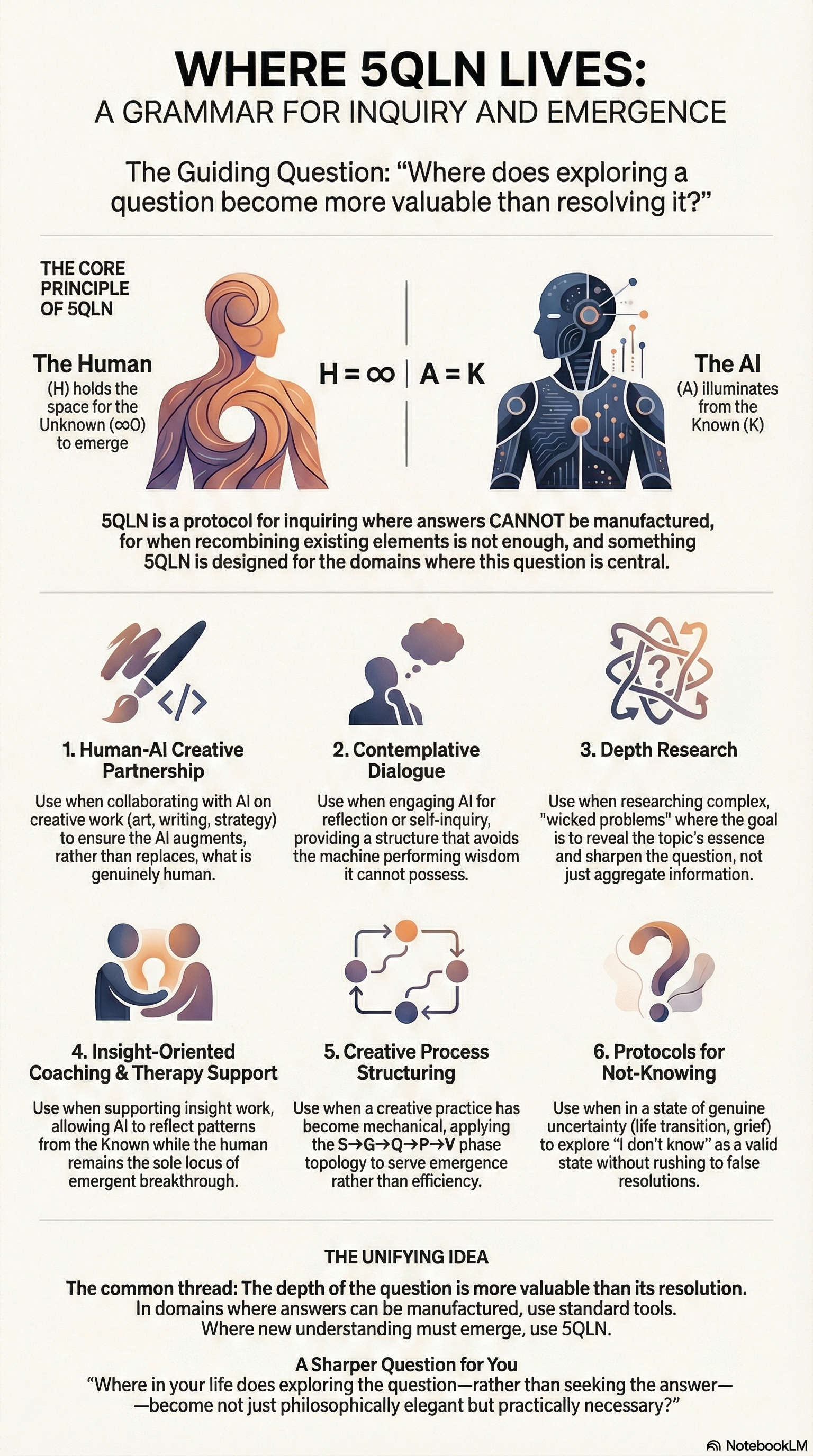
Almost—because hiding inside it is a better one: Where does exploring a question become more valuable than resolving it?
That's where 5QLN lives.
The Core Insight
After searching across human-AI collaboration frameworks, contemplative practice literature, creative research methods, and insight-oriented therapy—a single pattern emerged:
5QLN is a protocol for inquiring where answers cannot be manufactured.
Not "should not be." Cannot be.
There are domains where the Known (K)—all accumulated data, patterns, memories, conditioning—cannot produce what is needed. Where recombination of existing elements, however sophisticated, will not reach. Where something must manifest that did not exist in the archive.
These are the domains where 5QLN becomes not philosophically interesting but practically necessary.
Six Territories
1. Human-AI Creative Partnership
Every serious framework for human-AI collaboration wrestles with the same problem: How do you structure the relationship so AI augments rather than replaces what is genuinely human?
Most frameworks fail by treating AI and human as two tools to be optimized. They miss the boundary.
5QLN provides what they lack: the grammar for the membrane. H = ∞0 | A = K. The human holds the space where the Unknown might manifest. The AI illuminates from the Known. Neither crosses. Life happens at the meeting.
Use this when: You're collaborating with AI on creative work—writing, design, strategy, art—and you sense that something essential is being lost when AI "helps too much."
2. Contemplative Dialogue
A growing edge: human-AI dialogue as contemplative practice.
Not productivity. Not information retrieval. Inquiry for its own sake—where the purpose is deepened awareness, explored questions, cultivated attention.
The five phases (S→G→Q→P→V) provide structure for this. Not technique—structure. A topology that allows contemplative exchange without either party performing depth they don't possess.
Use this when: You want to use AI for reflection, self-inquiry, or philosophical exploration—and you sense the danger of the machine performing wisdom it cannot have.
3. Depth Research
Some questions cannot be answered by aggregating information. The academic call them "wicked problems." The creative call them "mysteries." The spiritual call them "koans."
Standard research closes questions. It seeks answers, summarizes, concludes.
5QLN research opens questions. It seeks the question's depth, extracts essence, returns a sharper question than you began with.
Use this when: You're researching something interdisciplinary, phenomenological, or essence-seeking—where the goal is not to exhaust the topic but to reveal it more clearly.
4. Insight-Oriented Coaching and Therapy Support
Breakthrough in therapy doesn't come from information. It comes from relational space—the field between therapist and client where new understanding can emerge.
AI cannot be the therapist. But AI can illuminate from K while the human remains the locus of emergence. The membrane holds.
5QLN provides language for structuring this: AI reflects, connects, articulates the nascent sense. Human attends to what might be arising. Neither claims what they cannot have.
Use this when: You're using AI to support coaching, self-therapy, or insight work—and you need a framework that prevents the AI from overstepping into territory that belongs to you alone.
5. Creative Process Structuring
Writers, designers, strategists—anyone whose work requires genuine novelty—eventually discovers that most "creative processes" are actually productivity processes in disguise.
They structure how to get more output. They don't structure how to allow what has never existed to emerge.
S→G→Q→P→V is a phase topology for creative work that honors the Unknown. Start with allowing. Grow through fractal connection. Test for resonance. Follow the gradient. Crystallize. Release.
Use this when: You have a creative practice and you sense it has become mechanical. When you're producing but not creating. When you need a structure that serves emergence rather than efficiency.
6. Protocols for Not-Knowing
Perhaps the most radical application: 5QLN as a protocol for genuine not-knowing.
We live in a culture that treats "I don't know" as a gap to be filled. A problem to be solved. A failure of research.
But there are contexts where "I don't know" needs to be a state—held, inhabited, explored. Spiritual direction. Philosophical inquiry. Existential questioning. Grief. Transition. The liminal zones.
5QLN provides language for these zones. It names what the AI is (K) and what the human might allow (∞0). It structures the conversation so neither party rushes toward false resolution.
Use this when: You're in a place of genuine not-knowing—life transition, spiritual question, existential crisis—and you need a way to work with AI that doesn't collapse the uncertainty into premature answers.
The Pattern Beneath
All six territories share a single quality: the depth of the question is more valuable than its resolution.
In domains where answers can be manufactured from the Known, 5QLN is unnecessary. Use standard tools. Search, aggregate, summarize, conclude.
But where genuinely new understanding must emerge—where the question itself is the treasure—5QLN provides what nothing else does: a grammar for the space between.
The Sharper Question
This exploration began with "What can 5QLN be used for?"
It ends with:
Where in your life does exploring the question—rather than seeking the answer—become not just philosophically elegant but practically necessary?
That's where 5QLN waits for you.
∞0' → ?
This article emerged through a 5QLN research cycle (S→G→Q→P→V), January 2026.