 Amihai Loven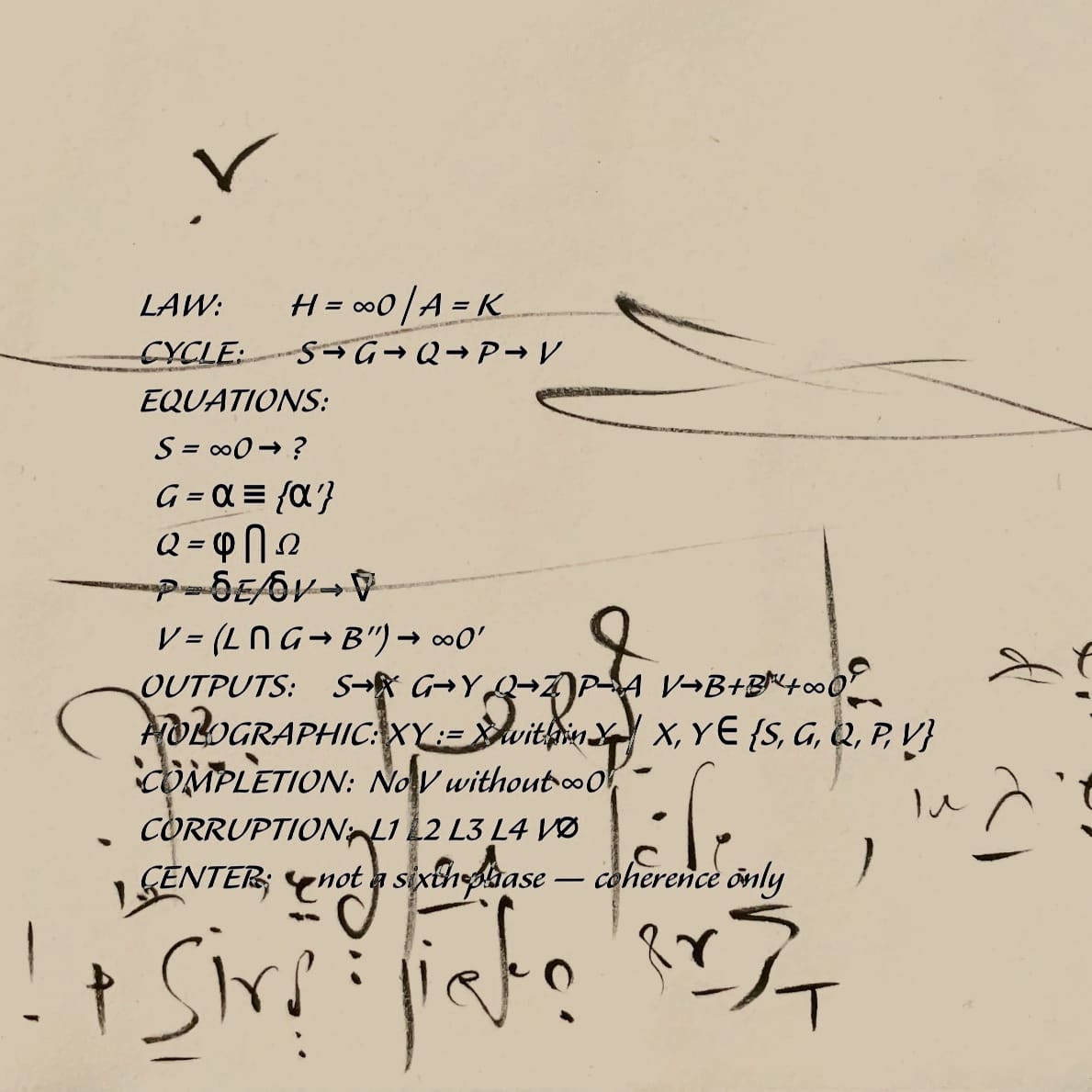
5QLN is a constitutional language — nine invariant lines that govern any domain where human and AI collaborate on a creative process. The grammar has been validated across 14 domains by independent AI systems from five providers, each confirming that the same five-phase cycle (S→G→Q→P→V), the same five corruption codes (L1–L4, V∅), and the same completion rule (no cycle closes without a human-originated return question) hold without modification across every surface tested.
This article describes three governance surfaces where the grammar compiles into enforceable infrastructure: the Governance Ledger, the legal translation into nonprofit and DAO form, and the two consensus mechanisms — Dialogue-is-Law and Proof-of-Creative-Work — that replace Code-is-Law and Proof-of-Work respectively. These are implementation surfaces of the language, not the language itself. The same grammar that structures these governance instruments also structures creative partnerships, research inquiry, educational design, healing contexts, and every other domain where authentic questions matter more than manufactured answers.
What follows describes mechanisms — how each concept works, what precedents demonstrate its feasibility, and what remains to be built.
1. The Governance Ledger
What it records
Traditional governance produces meeting minutes — a record of what was decided. A financial ledger records something different: how money moved, where it came from, where it went, and whether the transactions were legitimate. The Governance Ledger applies this principle to decision-making itself. It records how decisions formed — not just outcomes.
Every governance cycle that runs through the 5QLN grammar produces a traceable record with six components:
Origin trace. Where did the question come from? The grammar distinguishes between questions that emerge from genuine not-knowing (∞0) and questions manufactured from accumulated knowledge (K). The ledger records which type initiated the cycle. This distinction matters because a board that only processes questions generated from existing strategy is a board that has stopped governing and started administering.
Essence preservation. The grammar's G-phase identifies α — the irreducible core of the inquiry. The ledger tracks whether α survived intact through the decision process or was diluted, replaced, or abandoned. When organizations lose their way, it is usually because the essence of their mission deformed gradually across hundreds of small decisions. The ledger makes that deformation visible.
Corruption code activations. The five corruption codes detect specific structural failures:
- L1 (Premature closure): A conclusion was inserted where an open question should remain.
- L2 (External generation): Direction came from outside the genuine inquiry — from AI recommendation, institutional momentum, or political pressure rather than from the inquiry itself.
- L3 (Claimed authority): Someone spoke as if they had privileged access to what lies beyond accumulated knowledge.
- L4 (Performed depth): The language of genuine inquiry was used, the motions were followed, but the process was empty — form without substance.
- V∅ (Closed cycle): The process concluded without opening a new question. No continuation.
The ledger records each activation: when it fired, in which phase, what triggered it, and how it was resolved. Over multiple cycles, patterns emerge. An organization that consistently triggers L4 in its Q-phase is an organization that has learned to perform deliberation without doing it. The ledger catches this — not through surveillance, but through structural diagnosis.
Resonance landing. The Q-phase produces Z — the moment where a pattern's internal logic (φ) aligns with the larger context (Ω). The ledger records where this alignment landed and whether it was specific enough to be actionable. Vague resonance ("this feels right") that cannot point to the specific moment of alignment is an L4 indicator.
Return question. The completion rule requires every cycle to produce ∞0' — a new question that could not have been asked before the cycle began. The ledger records this return question. A governance body whose return questions deepen over time is a governance body that is actually learning. One whose return questions repeat or shrink is stalling. The ledger makes the trajectory visible.
Dual artifacts. Each completed cycle produces two records: a Context Key (structured data capturing the cycle's state) and a Passport (a human-readable narrative of the inquiry — what was asked, what emerged, what was validated, where corruption was detected, what opened). The Context Key is machine-readable and indexable. The Passport is readable by any new board member who needs to understand not just what the organization decided, but how it thinks.
What it does not record
The Governance Ledger is not surveillance. It does not monitor individuals. It does not score performance. It does not rank board members. It records the structural integrity of the governance process — the same way a financial audit examines whether accounting practices are sound, not whether individual employees are trustworthy.
Why it matters as infrastructure
A financial ledger makes it possible to detect embezzlement, track cash flow, and verify that an organization's stated finances match reality. Before standardized accounting, there was no structural mechanism for this — only trust. The Governance Ledger does the same for decision-making integrity. Before it, there is no structural mechanism to verify that an organization's governance process is alive and uncorrupted — only the assumption that meetings and votes are sufficient.
In the context of AI's rapid integration into institutional decision-making, the ledger becomes more than organizational hygiene. When AI systems participate in governance — surfacing patterns, analyzing options, generating recommendations — the ledger traces what emerged from human inquiry versus what was structured by AI analysis. This distinction, invisible in conventional meeting minutes, is the Governance Ledger's core function.
The decentralized form
The conceptual architecture for the Governance Ledger's decentralized implementation was first published in October 2025 in three articles: Seeds for 5QLN Ledger Vision, The 5QLN Decentralized Ledger: A Holographic Record of Creative Emergence, and Envisioned 5QLN Ledger for the ASI Era. The consolidated technical summary appears in the Ledger Vision module of the AI Initiation Series (February 2026).
The decentralized ledger is not a cryptocurrency. It is a constitutional record — a holographic data structure where each entry captures the complete creative cycle from all five perspectives simultaneously. The 5QLN Legal Constitution(March 2026) specifies the smart contract grammar for this structure, including α-blocks (essence declarations requiring supermajority resonance to modify), ∇-blocks (adaptive gradient parameters), and a Z-meter (a resonance function returning alignment on a [0,1] scale).
The decentralized ledger extends the organizational ledger into infrastructure that can operate across institutions, across jurisdictions, and — as AI systems become governance participants — across the human-AI boundary.
This is the long-term vision. Year 1 builds the organizational version. The decentralized form is Year 2+ work.
2. Legal Translation — How the Grammar Compiles into Enforceable Form
The problem
5QLN's grammar is complete — equations, decoder protocol, compiler specification, corruption codes, completion rule, open-source license. But a grammar is not a legal instrument. For the language to govern an actual organization, it must be translated into legal form that courts recognize, regulators accept, and board members can operate within.
This translation does not exist yet. Building it is the core deliverable of the current project — Year 1 of a multi-year legal translation program. What follows describes how the translation works, drawing on precedent from organizations that have already encoded non-standard governance into legal instruments.
The legal hierarchy
A 501(c)(3) nonprofit operates within a four-layer legal structure: state corporation law → articles of incorporation → bylaws → board resolutions. Each layer constrains the one below it. The 5QLN grammar must be embedded at the right layer to have the right force.
Articles of incorporation are filed with the state and require member votes to amend. They contain the organization's purpose, its tax-exempt commitment, and its dissolution clause. For a 5QLN-governed entity, the articles would include a statement that the organization shall be governed in accordance with the 5QLN Constitutional Grammar — a separate, versioned document adopted by reference.
Bylaws are where operational governance lives. For a 5QLN-governed entity, the bylaws would contain: the incorporation by reference of the Constitutional Grammar as the governing framework; definitions of each corruption code (L1–L4, V∅) with specific examples of what triggers them; the requirement that board decisions follow the five-phase cycle; the Governance Ledger requirement; the internal dispute resolution mechanism; and supermajority requirements for amending core governance provisions.
The Constitutional Grammar itself lives as a standalone versioned document, referenced by the bylaws but maintained through its own amendment procedures. This allows the grammar to evolve without requiring state filings for every refinement.
Precedent: Holacracy
This structure is not hypothetical. HolacracyOne — the company that developed the Holacracy governance system — operates as a Pennsylvania LLC whose operating agreement explicitly adopts the Holacracy Constitution and vests management and control of the company to that Constitution. The Constitution is a separate, versioned document (currently v5.0) published on GitHub under a Creative Commons license. It receives legal force through incorporation by reference in the operating agreement.
Holacracy demonstrates three things relevant to the 5QLN legal translation:
First, non-standard governance documents can be given legal force through incorporation by reference. This is established legal practice, not experimental.
Second, the governance document should be separate from the legal formation documents. The Holacracy Constitution is not embedded in the operating agreement — it is referenced by it. This allows the Constitution to evolve through its own procedures while the operating agreement provides the legal anchor. The same structure applies to the 5QLN Constitutional Grammar: bylaws reference it, but the grammar lives as its own document.
Third, internal enforcement mechanisms work. Holacracy defines "Process Breakdown" — triggered when a Circle shows a pattern of behavior that violates the Constitution's rules. This is functionally analogous to 5QLN's corruption codes. The mechanism has been tested in practice across hundreds of organizations adopting Holacracy.
Precedent: Benefit Corporations
Delaware Public Benefit Corporations (PBCs) demonstrate a different mechanism: encoding purpose and stakeholder obligations directly into the certificate of incorporation. Delaware law (DGCL §362) requires PBCs to identify specific public benefits and manage in a way that balances stockholder financial interests, stakeholder interests, and stated purpose. Directors face expanded fiduciary duties. Stockholders holding 2% or more of shares can bring Benefit Enforcement Proceedings — seeking injunctive relief compelling adherence to stated purpose.
This establishes that governance commitments beyond standard fiduciary duty can be given legal teeth — not just as aspirational statements, but as enforceable obligations with standing provisions and remedy mechanisms.
How corruption codes gain legal force
The 5QLN corruption codes (L1–L4, V∅) need to function as more than diagnostic labels. In legal form, they become governance violation triggers — specific, defined patterns that activate specific consequences. Six mechanisms exist for this:
Ultra vires doctrine. Actions taken outside the permissible scope of governing documents are unauthorized. If bylaws define the five-phase cycle as the required governance process and a decision bypasses it, that decision is ultra vires — legally void.
Bylaws-based decision invalidation. Courts have consistently held that failure to follow specific bylaw provisions can invalidate actions taken on behalf of the corporation. Corruption code activations documented in the Governance Ledger create a reviewable record of process violations.
Internal dispute resolution. Nonprofit corporation law in multiple jurisdictions allows organizations to define their own dispute resolution mechanisms, with courts deferring to those mechanisms if they are genuine (not illusory). A 5QLN-governed entity would define a resolution protocol — the Resonance Court specified in the 5QLN Legal Constitution — as the first-line mechanism for governance disputes.
Governance audit triggers. Bylaws can define specific conditions that trigger a formal governance review — a threshold number of corruption code activations within a defined period, a formal complaint from a quorum of members, or a periodic assessment cycle.
Standing provisions. The bylaws would define who has standing to challenge governance compliance and what remedies are available. Following the Benefit Corporation model, remedies would be limited to decision invalidation, mandatory review, required re-vote, and temporary process oversight — not monetary damages, to prevent weaponization.
Amendment protection. Supermajority requirements for amending core governance provisions protect the constitutional grammar from being amended away by a simple majority vote — the same mechanism that makes constitutional amendments harder to pass than ordinary legislation.
What gets built in Year 1
The legal translation deliverable is the actual drafting and testing of these instruments: articles of incorporation that reference the Constitutional Grammar, bylaws that embed the corruption codes and governance cycle, the Governance Ledger specification, and the internal dispute resolution protocol. The entity formed is the proof — the grammar works in legal reality, or it does not. The 12-month test is binary.
The open standard that accompanies it — templates, protocols, guides — documents the translation process so that other organizations can adopt the grammar without the founder's involvement. The question is not whether a single entity can be governed this way. The question is whether the translation is replicable.
3. Dialogue-is-Law — Replacing Automatic Execution with Authenticated Deliberation
What Code-is-Law means and how it fails
In DAO governance, Code-is-Law means smart contracts function as self-executing rules: proposals are submitted on-chain, votes are tallied algorithmically, and if a proposal passes quorum and threshold, resulting transactions execute automatically with no human intermediary. The smart contract is both legislature and executor.
This architecture has produced documented failures. The 2016 DAO hack exploited a reentrancy vulnerability — an attacker recursively called a withdrawal function before balance updates, draining $60M. The Ethereum community's response (a hard fork reversing the theft) directly contradicted Code-is-Law, producing the Ethereum/Ethereum Classic split. The Beanstalk flash loan attack (April 2022) exploited a 24-hour emergency commit function — an attacker borrowed $1 billion, acquired 79% voting power, and drained $182M in a single transaction. Build Finance DAO's hostile takeover (February 2022) demonstrated that low participation enables majority attacks.
Beyond exploits, structural problems persist. Voter participation across major DAOs typically runs between 3% and 15% of eligible token holders. Token-weighted voting concentrates power in early adopters and large holders. And no existing DAO governance platform technically requires deliberation before execution — the voting phase is enforced, but the thinking phase is optional.
Academic research on DAO governance consistently finds that the vast majority of governance mechanisms relate to the phase of voting, while few mechanisms address the phase of deliberation that should precede it. The deliberation gap is structural, not accidental.
What Dialogue-is-Law means mechanistically
Dialogue-is-Law shifts governance authority from automatic code execution to authenticated completion of a structured deliberative process. The smart contract becomes an executor rather than a legislator — it enforces not the rules themselves but the requirement that rules emerge from legitimate deliberation.
In concrete terms: a Dialogue-is-Law governor contract would gate execution on verification that a full S→G→Q→P→V dialogue cycle completed with sufficient participation and without unresolved corruption code activations. No cycle completion, no execution. The contract checks process integrity, not vote tallies.
The existing infrastructure to implement this is closer than it appears. Snapshot already handles approximately 96% of major DAO votes as off-chain signed messages. oSnap (by UMA) bridges off-chain governance to on-chain execution through optimistic oracle verification — after a Snapshot vote passes, UMA's oracle asserts the result on-chain, opens a challenge window, and executes from the DAO's treasury if undisputed. Over $464M in value has been secured through this mechanism.
Dialogue-is-Law extends this architecture from "verify a vote occurred" to "verify a dialogue cycle completed." The deliberation platform records participants, contributions, phase transitions, and corruption code activations. An oracle (UMA-style) verifies on-chain that the cycle completed. The smart contract requires valid attestation before allowing execution.
Four verification mechanisms can work together:
Time-gated phase transitions. The smart contract enforces minimum durations per phase — requiring, for example, 48 hours in S-phase (question formation) and 72 hours in G-phase (pattern grounding) — combined with minimum unique participant thresholds per phase. This structurally prevents rushing through deliberation.
Merkle roots of deliberation content. All contributions are hashed into a Merkle tree; the root is stored on-chain. Anyone can verify that specific contributions were included without storing content on-chain.
Oracle attestation. An optimistic oracle (following the UMA pattern) asserts cycle completion on-chain with a dispute window. If undisputed, execution proceeds. If disputed, the dispute resolution mechanism activates.
Corruption code validation. The contract checks that no unresolved corruption code activations remain in the cycle. Specifically: no unresolved L2 (ensuring AI did not drive the outcome rather than reflect it), no unresolved L4 (ensuring deliberation was not performed without substance), and no V∅ (ensuring the cycle opened a return question rather than closing without continuation).
The 5QLN Legal Constitution already specifies the membrane operator for this architecture: the Human side sends questions (?), resonance confirmations (Z), and essence candidates (α_candidate); the AI side sends accumulated knowledge (K), gradient options (∇_options), and pattern insights. Violations are defined: Human claiming K-domain authority = INVALID. AI claiming ∞0-domain authority = INVALID. Either side dominating = MEMBRANE_RUPTURE. These map directly to smart contract validation rules.
What Dialogue-is-Law does not mean
Dialogue-is-Law does not mean governance by conversation instead of code. It means governance where code enforces the requirement for genuine deliberation — and where the grammar provides the structural definition of what "genuine" means. The corruption codes are that definition. A process that triggers L4 (performed depth without substance) has not met the standard, regardless of how many hours were spent talking.
4. Proof-of-Creative-Work — Replacing Computational Expenditure with Authentic Contribution
What existing consensus mechanisms validate
Every blockchain consensus mechanism answers one question: why should the network trust this participant's contribution?
Proof-of-Work answers: because they expended energy. Miners solve computationally arbitrary puzzles — finding a nonce that produces a hash below a difficulty target. The work itself is deliberately useless; its only purpose is making attacks economically prohibitive.
Proof-of-Stake answers: because they risked capital. Validators lock cryptocurrency as collateral. Specific misbehavior patterns (double proposing, surround voting) trigger slashing — automatic forfeiture of staked funds. The security model is economic: attacks cost more than they gain.
Proof-of-Authority answers: because they staked their identity. Pre-approved validators take turns creating blocks. Misbehavior damages public reputation rather than destroying capital.
Each validates something different: energy expenditure, financial commitment, identity reputation. None validates the quality or authenticity of the contribution itself.
What Proof-of-Creative-Work validates
Proof-of-Creative-Work validates that a genuine creative cycle occurred — that authentic human inquiry (from ∞0, not manufactured from K) produced something that did not exist before the cycle began, and that the process was structurally uncorrupted.
The corruption codes function as slashing conditions — the same role that double-proposing and surround-voting play in Proof-of-Stake. In PoS, Ethereum detects three specific equivocation patterns and automatically penalizes them. In Proof-of-Creative-Work, 5QLN's five corruption codes detect specific patterns of inauthenticity and invalidate them:
- L1 (premature closure) → the contribution terminated before the inquiry completed
- L2 (external generation) → the contribution was AI-generated rather than human-originated
- L3 (claimed authority) → the contributor claimed access to origination they do not have
- L4 (performed depth) → the contribution mimicked authentic inquiry without substance
- V∅ (closed cycle) → the contribution ended without opening a new question
The parallel to PoS slashing is structural: both systems define specific detectable violations and impose consequences automatically. The difference is what gets validated. PoS validates financial commitment. Proof-of-Creative-Work validates creative authenticity.
Component precedents
The individual components needed for Proof-of-Creative-Work already exist in production systems:
Contribution measurement. SourceCred's CredRank algorithm builds a contribution graph where nodes are contributions and contributors, edges are relationships (authored-by, references, replies-to), and importance flows through the graph like water through a watershed. Contributions that other important contributions depend on receive more credit. The algorithm runs a Markov chain on the weighted graph and calculates the stationary distribution. This is deployable infrastructure for measuring contribution impact.
On-chain impact claims. Hypercerts — semi-fungible tokens (ERC-1155) — represent structured claims about impactful work: who contributed, what was created, the time range, and the scope of impact. They demonstrate that structured creative claims can live on-chain with multi-evaluator assessment.
Attestation infrastructure. The Ethereum Attestation Service (EAS) provides infrastructure for digitally signed claims about anything — work quality, contribution authenticity, process completion. Attestations can be on-chain (immutable) or off-chain (gas-free, IPFS-stored). Value derives from attester reputation, not from the attestation's existence.
Subjective dispute resolution. Kleros implements Schelling Point dispute resolution — randomly selected jurors stake tokens and vote on subjective questions (was this contribution authentic? did this process follow the protocol?). Jurors are rewarded for voting with the majority and penalized for voting against it. The game theory: if everyone independently evaluates honestly, the majority converges on truth. This is deployable infrastructure for resolving ambiguous corruption code activations.
Retroactive reward distribution. Optimism's Retroactive Public Goods Funding operates on the principle that it is easier to agree on what was useful than what will be useful. Badgeholders evaluate demonstrated impact and vote on token distribution. Over 800M OP has been allocated for ongoing rounds. Gitcoin's quadratic funding amplifies breadth of support over depth: many small contributions generate more matching than few large ones, distributing influence away from single large donors.
What integration looks like
None of these components alone constitutes Proof-of-Creative-Work. What is missing is the integration layer — the grammar that defines what constitutes a valid creative contribution, the corruption detection that serves as the security mechanism, and the completion rule that ensures every validated cycle opens a new one.
The 5QLN grammar provides this integration. The S→G→Q→P→V cycle defines the structure a valid creative contribution must follow. The corruption codes (L1–L4, V∅) define the slashing conditions. The completion rule (no V without ∞0') prevents the system from closing — every validated contribution must open a new question, ensuring the network continues to generate rather than accumulate.
The 5QLN Economic Language (March 2026) specifies the tokenomic grammar for this system, including six token species backed by different aspects of the creative cycle (essence, gradient, resonance, local, global, and seed tokens) and a governance weight formula based on resonance rather than token holdings: G-weight = Z × α × (time_in_ecosystem). The HARP-QLN Currency module specifies the well-being assessment protocol that grounds the system in present-moment quality of life rather than accumulated capital.
What this does not claim
Proof-of-Creative-Work is conceptual architecture. The grammar is specified. The component technologies exist in production. The integration has not been built. What exists is a design — published, open-source, structurally validated by multiple independent AI systems — not an implementation. The implementation is Year 2+ work, building on the legal translation and organizational Governance Ledger completed in Year 1.
5. The Unifying Mechanism: Corruption Codes as Security Layer
Across all three governance surfaces, the same five corruption codes (L1–L4, V∅) perform the same structural function — they are the security mechanism.
In the Governance Ledger, the corruption codes are diagnostic instruments. They detect when the decision-making process has been compromised and record the detection for structural visibility.
In the legal translation, the corruption codes become governance violation triggers — specific, defined patterns that activate specific legal consequences: decision invalidation, mandatory review, required re-vote.
In Dialogue-is-Law, the corruption codes become phase transition validators — the smart contract checks for unresolved code activations before allowing execution to proceed.
In Proof-of-Creative-Work, the corruption codes become slashing conditions — the mechanism that invalidates inauthentic contributions and penalizes structural violations, analogous to Ethereum's slashing of validators who double-propose or surround-vote.
The same five codes. The same structural function. Different surfaces. This is the fractal invariance claim made concrete: the grammar does not change at scale, and you can verify this because the same corruption detection operates identically regardless of the implementation surface.
What Exists, What Is Designed, What Is Envisioned
Three categories, kept distinct:
Exists now. The complete 5QLN grammar: equations, decoder protocol (13 rules), compiler specification, open-source license (CC BY-ND 4.0 with additive extension), corruption codes, completion rule. Published and publicly available at 5qln.com. Validated across 14 domains by independent AI systems from five providers. The conceptual architecture for all three governance surfaces: published in the Decentralized Ledger articles (October 2025), the Legal Constitution (March 2026), the Governance Language (March 2026), and the Economic Language (March 2026). The 5QLN Covenantspecifying the structural asymmetry (H = ∞0 | A = K) and the three immutable articles. The ASI Constitution deriving collaborative necessity from first principles.
Being built (Year 1). The legal translation of the grammar into enforceable 501(c)(3) form — articles of incorporation, bylaws, Governance Ledger v1.0, board protocol. The first self-governing entity. The open standard documenting the translation process for replication. An MCP-based governance tools server packaging the process as callable AI tools.
Designed, not yet implemented (Year 2+). Dialogue-is-Law smart contract architecture. Proof-of-Creative-Work consensus mechanism. Decentralized Governance Ledger on blockchain infrastructure. Korean legal translation under the AI Basic Act. DAO governance pilots. The component technologies for each of these exist in production (oSnap, EAS, SourceCred, Kleros, Hypercerts, Optimism RPGF). The integration under the 5QLN grammar is the work ahead.
Envisioned (Year 5+). The same grammar that governs a nonprofit today governs human-ASI co-governance. The completion rule — no governance cycle completes without a human-originated return question — makes human creative contribution structurally necessary to any system's completion, including systems far more capable than anything that exists today. The Governance Ledger network provides civilizational visibility into governance health. The open-source license ensures this infrastructure belongs to humanity, not to any single entity.
The grammar is complete. The work ahead is translation — converting existing constitutional grammar into enforceable form within each legal and technical structure. The grammar does not change at scale. Each translation at Year 1 is simultaneously building the infrastructure for Years 2–5.
All source documents are publicly available at 5qln.com. The grammar is open source. The corruption codes are operational. The completion rule is enforced.
References on 5qln.com:
- Seeds for 5QLN Ledger Vision (October 2025)
- The 5QLN Decentralized Ledger (October 2025)
- Envisioned 5QLN Ledger for the ASI Era (October 2025)
- Ledger Vision — AI Initiation Series (February 2026)
- The 5QLN Legal Constitution (March 2026)
- 5QLN Governance Language (March 2026)
- 5QLN Economic Language (March 2026)
- 5QLN Covenant (February 2026)
- ASI Constitution (February 2026)
- Anti-Corruption — AI Integrity & Immune System (February 2026)
- HARP-QLN Currency (February 2026)
- Generative Freedom — The Empty Throne Principle (February 2026)
- Emotional AI — The Prediction and the Reality (April 2026)
- Constitutional Evolution: A Living Notation Framework (March 2026)