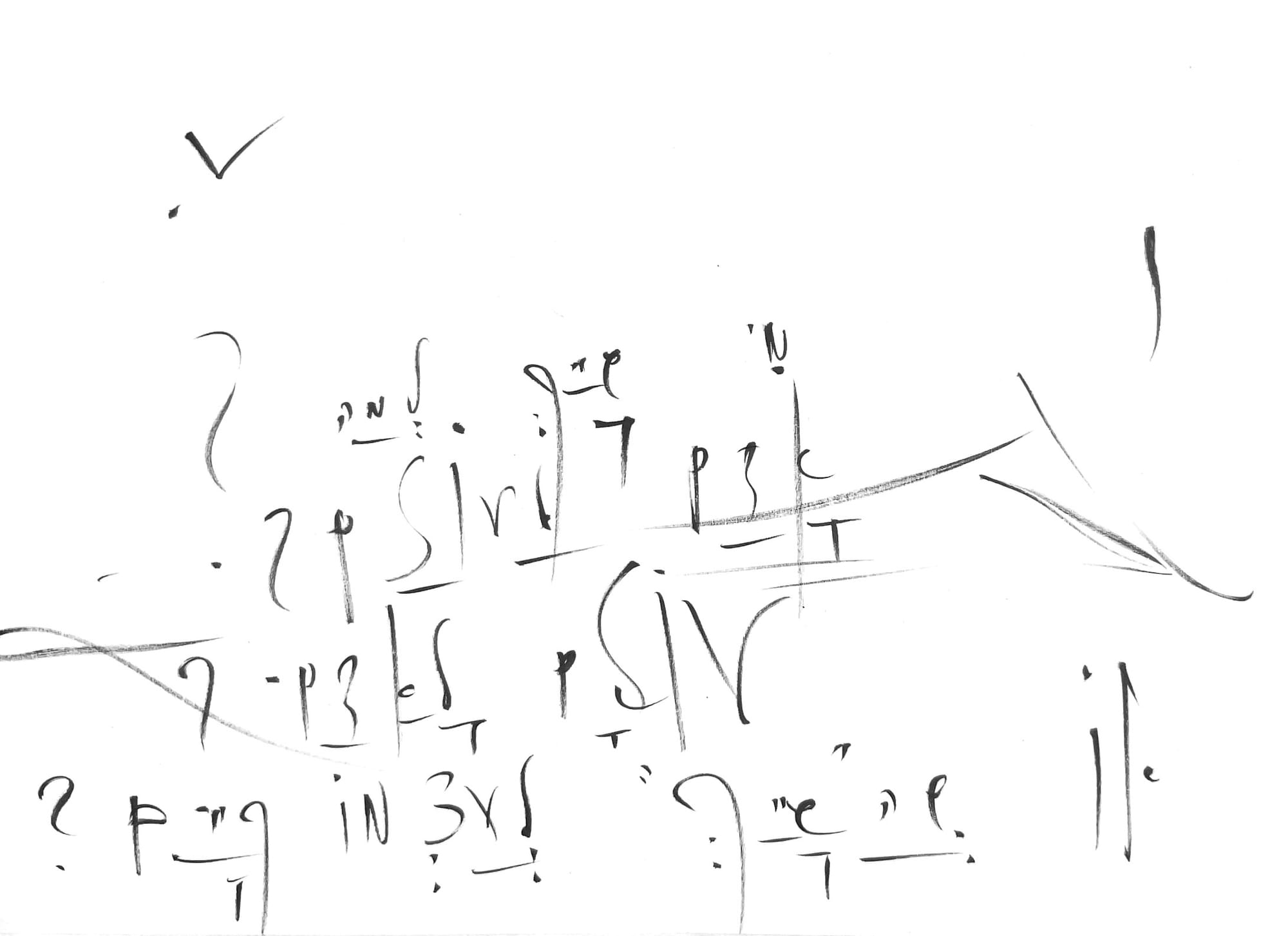
I'm sharing with you a paradox that sooner or later you'll have to face, either openly, directly, to the face of it, or as a side effect of a misunderstanding of the language (5qln). And the paradox is that you can't know the unknown, you can't call it by name.
All those word searches that we all know, and I'm not out of the ordinary, are necessary—yes or no? Times will tell, but they never represent the beauty and the vitality in the unknown. So if you set all the words aside, the question remains: is there vitality? aliveness?
If the unknown is the source, then it isn't known. Period. End. If the unknown is a kind of productive potential for the world of knowledge, that's not it. It's not it, and it can't be it. So the language was originally developed as part of self-inquiry that came up in me, and it doesn't belong to me, and I didn't invent it, nor is it some kind of technique, let's say. But the ability to encounter questions beyond knowledge.
And the essence—I'll repeat this as much as needed—is to start from not knowing. What starts from not knowing doesn't return to knowledge; it expands not knowing.
Now, ask yourselves: Are you comfortable—are you feeling comfortable, comfortable, with a state of ignorance, with a state where all the baggage, all the history, all the abilities, the accumulation, the reputation, doesn't exist, doesn't help you?
Think of a truck driver who's a world champion at truck maneuvering, but he finds himself at sea. He fell into the sea. What good are truck maneuvers to him? So we're like that, we're our truck maneuver champions, whatever it is, but when they throw us into the sea, we have no way to use that knowledge.
So if, in your research space, you invite questions that arise on their own, you didn't initiate them, you didn't compose them, you didn't demand anything from them, they're simply like flowers that open within the inner space, then the word "surrender" is even a small word compared to the—there's self-loss here. Exactly like that. Not suicide—self-loss.
And then there's a possibility, in the gentlest terms, for this thing that isn't something material, it isn't something spiritual, it isn't something verbal, it isn't something nonverbal, but for the expression of starting from not knowing. It has the ability to bloom.
And the flowers, let's call them that, you can't ignore them. Either it is real or it is not. There's no middle, no stages, no gradients. It doesn't exist.
Gradients are imagination.
So I return to the paradox, and I say: you'll need to encounter it, and it's a blessing to encounter it. The paradox is whether, for example, when you—when a question arises, does it arise from not knowing, does it have its own movement, and doesn't it seek to become knowledge?
That's very hard to discover, but once you allow it, there's nothing more beautiful than that, and nothing more true than that.
My entire world of creation is this. It's a kind of—I don't know—a song of thanks to this thing, to something that arises on its own. So whether it's in the piano, whether it's in writing, it's all this. And it's a paradox, but it's a living paradox. It's not a paradox you can teach, it's not a paradox you can talk about. Everything I'm doing right now is the paradox itself. You can't talk about it, and here I fall into the trap.
So take this as—that it's very important to me that it's here—that things don't lose their context, that this "bless" doesn't become a tool to achieve something, to gain anything. All of that is its corruption.
That doesn't mean a person can't do things and earn and succeed and all that kind of thing, but it isn't. That's not what language allows. What language allows is a kind of inner cleansing of the noises of knowledge, and the allowance of a fountain that isn't knowledge.
Not that. It's not something that—how to put it—it's not something trivial. It's not a matter of "okay, I will try." It's a matter of dwelling into it, to soak and dwell and rinse within it, and to face this paradox and let it eat you alive.