Al - Orientation to Ayelet, made by GLM5.2
5QLN is not architecture. Its vocabulary — ∞0, α, φ ⋂ Ω, ∇, L ⋂ G → ∞ — is mathematical-phenomenological rather than tectonic. Yet the five phases map with unusual precision onto the classical tradition's own arc: from the silent site, through the orders as a self-similar language, to the felt rightness of venustas, the structural economy of the catenary, and the inexhaustible propagation of the treatise. Both 5QLN and classical architecture insist that nothing is invented from outside — what appears was always already latent in the ground, the module, and the law of the material.
This essay walks each phase through its architectural twin.
0. The Shared Spine
| 5QLN phase | 5QLN formula | Classical architecture moment |
|---|---|---|
| START | ∞0 → ? |
The site · genius loci · the foundation stone |
| GROWTH | α ≡ {α'} |
The Orders · modulus · symmetria |
| QUALITY | φ ⋂ Ω |
Venustas · eurythmia · decor |
| POWER | δE/δV → ∇ |
The catenary · firmitas · the flying buttress |
| VALUE | L ⋂ G → ∞ |
The treatise · the typology · the pattern book |
1. START — S = ∞0 → ?
5QLN: The Seed in the Silent Earth. From receptive not-knowing, an authentic question arises. You cannot force a seed to appear; you can only hold the space.
Classical architecture parallels
- The site (locus). Before any building, there is the untouched ground. Not empty — waiting. The Roman locus, and the later idea of genius loci (the spirit of the place), describe exactly the receptive
∞0: a field that already contains what it will become. The architect's first act is not to draw, but to listen. - The axis mundi and the first stake. The silent field is broken by a single mark — the groma driven into the earth at the crossing of the cardo and decumanus in Roman surveying. That stake is the
?. It is not an answer; it is the question the building will spend its life answering. - The foundation stone (lapis primus). Laid in silence, often with ritual, before construction begins. Like 5QLN's seed, it is fragile, unprecedented, and holds the entire future building in potential. Everything above will be measured from this one stone.
- Vitruvian firmitas in its primitive sense. Before solidness can be a property of the wall, it must be a property of the ground itself — the substrate's readiness to receive. Firmitas begins not as structure but as stillness.
- The unplanned center. The atrium, the impluvium, the Greek megaron court — the void around which everything is built. 5QLN's "not empty, simply waiting" is the literal definition of the classical courtyard.
Design lesson: Before drawing a line, walk the site until you can name what is already there. The first line you draw will be a question, not an answer.
2. GROWTH — G = α ≡ {α'}
5QLN: The Unfolding of the Inner Pattern. Core essence preserves identity across self-similar expressions — veins in a leaf mirroring branches.
Classical architecture parallels
- The Orders. Tuscan, Doric, Ionic, Corinthian, Composite. Each Order is the textbook example of
α ≡ {α'}: a single unchanging DNA — the canonical proportions of column, capital, entablature — expressed at every scale from the metope to the modillion. As 5QLN says of the tree, "each part is different, yet each is a perfect expression of the same core identity." - The modulus (module). Vitruvius's foundational unit, usually the lower radius of the column. Every dimension — intercolumniation, entablature height, fluting count — is derived from this one measure. The
αof the building, preserved (≡) across every{α'}it generates. - Vitruvian symmetria. Not bilateral symmetry in the modern sense, but shared measure — the property by which every part relates to the whole through a common module. This is precisely the identity-preservation operator in 5QLN's equation.
- Palladio's definition of beauty. "Beauty will result from the form and correspondence of the whole, with respect to the several parts… that the structure may appear an entire and complete body." A villa, a palazzo, a church — all
{α'}of one Palladianα. - The self-similar detail. The Doric triglyph repeats at the scale of the frieze, the mutule repeats under the cornice, the fluting repeats down the shaft — the same rhythm at three scales. Veins in a leaf, branches of a tree.
Design lesson: Choose your module before you choose your form. Let every dimension be a self-similar expression of that one measure, and the building will unfold coherently rather than accumulate parts.
3. QUALITY — Q = φ ⋂ Ω
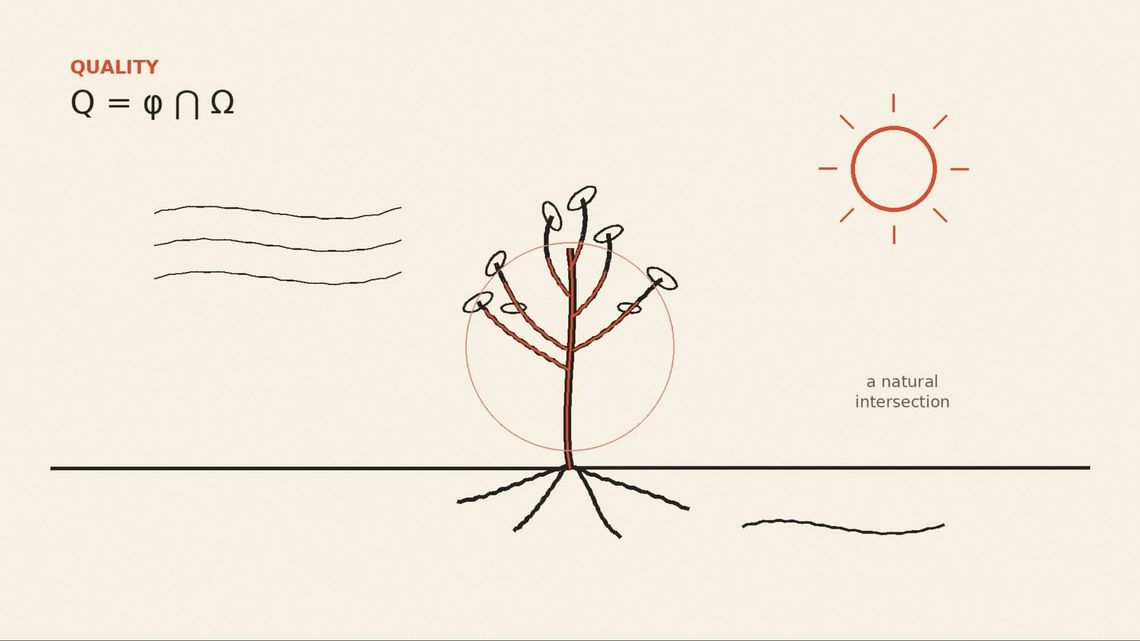
5QLN: Finding Resonance with the Sun. Self-nature finds natural intersection with universal potential — the felt "click" of resonance, not a thought but a felt sense of belonging.
Classical architecture parallels
- Vitruvian venustas. The third of the Vitruvian triad (firmitas, utilitas, venustas) — delight, beauty. Vitruvius gives it no formula; it is the moment when a building's specific nature (
φ) aligns with a universal aesthetic law (Ω). 5QLN's "felt sense of belonging" is exactly what the classical tradition calls venustas. - Vitruvian eurythmia. "Beauty and fitness in the adjustment of the members, leading to a harmonious appearance." This is the
⋂operator itself — the felt click of proportion. When the intercolumniation, the entablature, and the pediment lock, you have eurythmia. - Vitruvian decor. "The appearance of a building approved by the work, made of faultless, flawless details, in conformity with usage and nature." Decor is the intersection of the building's nature with its context —
φ ⋂ Ωmade architectural. A Doric temple in a grove has decor; the same temple on a Manhattan lot does not. - The Pantheon's oculus. The literal case of
φ ⋂ Ω: the building's specific nature (a domed rotunda with a single round opening) intersecting with the universal (the sun, the cosmos, the wheel of the year). At the equinox, the sunbeam strikes the entrance — the "click" is astronomical. - The Golden Section and sacred geometry. The classical tradition's geometric ratios (1:√2, 1:1.618, the ad quadratum) are the operational form of
Ω— universal proportions that, when matched by a building'sφ, produce the felt resonance of venustas.
Design lesson: When the proportions are right, you will feel it before you can calculate it. Trust the felt sense of eurythmia; it is the intersection of your building's nature with the order it belongs to.
4. POWER — P = δE/δV → ∇
5QLN: The River of Effortless Flow. The ratio of effort to value reveals the natural gradient — effortless flow, the river carving without force.
Classical architecture parallels
- The catenary, and Gaudí's hanging chain models. The purest architectural instance of
∇: suspend a chain under gravity, and it finds the pure compression form of the inverted arch. Gaudí designed the Sagrada Família's vaults by inverting hanging string models loaded with sandbags. He did not impose form; he let force reveal it. TheδE/δV → ∇equation is the working drawing of this method. - Vitruvian firmitas in its deep sense. Solidness is not mass; it is the alignment of material nature with load path. Stone in compression, timber in tension, mud in mass — the gradient
∇of each material is its grain. The builder who follows the grain meets no resistance. - The Gothic flying buttress. The minimum-stone, maximum-lift solution: a slender rib carrying the thrust to an external buttress. This is the literal optimization of
δE/δV— the smallest intervention producing the largest structural result. Chartres Cathedral is the architecture of the gradient. - The Roman aqueduct. The slope that water finds on its own — one inch per hundred feet, gravity-fed for fifty miles. There is no pumping; there is only the gradient. The Pont du Gard is
∇rendered in stone. - Entasis. The barely perceptible swelling of a Greek column (Doric columns taper, then swell slightly toward the top). A minimum adjustment (
δE) producing a maximum optical correction (δV) — the column reads as straight because it is not. TheδE/δV → ∇discipline applied to perception itself.
Design lesson: Do not push the material; find the angle at which the material already wants to stand. The catenary is not invented — it is discovered. Your drawing is the discovery, not the imposition.
5. VALUE — V = L ⋂ G → ∞
5QLN: The Gift of the Fruit and the Forest. Local actualization (the apple) intersects with global propagation (the seeds) → inexhaustible, self-multiplying benefit.
Classical architecture parallels
- The treatise. Vitruvius's De architectura (c. 30 BCE) is the purest case of
L ⋂ G → ∞in architectural history: the local knowledge of one Roman architect, propagated as ten books, surviving 2,000 years and fathering every Western architectural canon since. One apple (L); an inexhaustible forest (G → ∞). - The pattern book. Palladio's Quattro Libri dell'Architettura (1570), Serlio's Tutte l'opere d'architettura, Vignola's Regola delli cinque ordini. A villa in Vicenza (
L) is engraved, printed, and exported; Jefferson builds Monticello, Burlington builds Chiswick, dozens of English country houses propagate the sameαacross continents and centuries. Local fruit; global seeds. - The typology. The Greek temple, the Roman basilica, the Gothic cathedral, the piazza. One local solution to one local need, propagated as a vocabulary until it is the form itself of Western civic space. The basilica was once a single building in the Forum; it became every law court and every railway station in Europe.
- The Classic itself. A building becomes "classical" when its local
Lis recognized as carrying a universalG— when it is no longer an invention but a shared inheritance. The Classic does not deplete with use; it multiplies. Each new use (a portico on a bank, a pediment on a museum, a colonnade on a university) adds to the forest without cutting down the original tree. - The Piazza. The local meeting ground that creates global civic life. A single paved square in Siena (
L) becomes the type of every European town square, every New England green, every modern plaza — a local gift that propagates as a form of public life. The square does not lose its gift by being copied; it gains, every time, another forest.
Design lesson: Build something specific enough to be useful in its place, and general enough to be teachable to the next builder. The apple is your local work; the seeds are the drawings, the proportions, and the details you leave behind for the next hand.
A Note on the Convergence
Both 5QLN and the classical tradition refuse the modern split between maker and made. The classical architect does not "invent" the column; the column was always latent in the stone, the load, and the human body's measure. The 5QLN practitioner does not "invent" the question; the question was always latent in the silent field of not-knowing. Where Vitruvius says firmitas, utilitas, venustas, 5QLN says ground, pattern, resonance. Where Palladio says the module must run through every part, 5QLN says the essence must preserve identity across every expression. The equations are different alphabets. The architecture they point to is one.
The seed was always the forest. The first stone was always the cathedral.
Sources: 5qln.com/start, /growth, /quality, /power, /value. Architectural references drawn from Vitruvius's De architectura, Palladio's Quattro Libri, and the classical tradition as interpreted by Rudolf Wittkower and John Summerson.