Orientation 2 to Ziv, made by GLM5.2
The price was always latent in the order book.
From the cash account as silent earth, through the factor model as creative DNA, to the felt click of price discovery, the gradient of the carry trade, and the inexhaustible compounding of the dividend.
5QLN is not finance. Its vocabulary — ∞0, α, φ ⋂ Ω, ∇, L ⋂ G → ∞ — is mathematical-phenomenological rather than monetary. Yet the five phases map with unusual precision onto the arc of financial practice: from the cash account as the silent site, through the factor model as a self-similar language of risk, to the felt rightness of margin of safety, the structural economy of the Sharpe ratio, and the inexhaustible propagation of compounding. Both 5QLN and the markets insist that nothing is invented from outside — what appears was always already latent in the order book, the position, and the law of risk and return.
This essay walks each phase through its financial twin. The aim is not to instrumentalize 5QLN for portfolio management; the equations are not technical indicators. It is to show that the same arc — receptive stillness, patterned unfolding, felt resonance, effortless flow, generative gift — describes what a serious investor actually does, even when the vocabulary of modern finance makes the correspondence hard to see.
0. The Shared Spine
The five 5QLN phases and the moments of financial practice they map onto. Read each row as a translation, not an analogy: the equation and the market structure point to the same act, expressed in different alphabets.
| 5QLN phase | 5QLN formula | Financial moment |
|---|---|---|
| START | ∞0 → ? | The cash account · the risk-free rate · the unwritten trade thesis |
| GROWTH | α ≡ {α'} | The factor model · CAPM beta · self-similar strategy across scales |
| QUALITY | φ ⋂ Ω | Price discovery · margin of safety · the felt click of mispricing |
| POWER | δE/δV → ∇ | The Sharpe ratio · the Kelly criterion · the carry trade |
| VALUE | L ⋂ G → ∞ | Compounding · the dividend · the open-ended fund |
1. START — S = ∞0 → ?
5QLN: The Seed in the Silent Earth. From receptive not-knowing, an authentic question arises. You cannot force a seed to appear; you can only hold the space.
Financial parallels
- Cash as a position. Before any trade, there is the cash account. Not empty — waiting. The T-bill yielding the risk-free rate is the financial equivalent of the silent earth: a field that already contains what it will become, since every position is born from cash and returns to it. The phrase "cash is a position" (attributed to Patrick Henry, codified by Bruce Greenwald) is exactly the 5QLN insight that ∞0 is not absence but pregnant potential. To hold cash is to hold the question.
- The unwritten thesis. Buffett's rule — "no called strikes in investing" — is the operational form of ∞0 → ?. The batter may wait indefinitely for the right pitch; the only called strike is the one swung at out of boredom. 5QLN's line, "You cannot force a seed to appear; you can only hold the space," could have been lifted from a value-investor's notebook. The authentic question — the authentic trade — is not manufactured but recognized when it appears.
- The blank order ticket. The empty order book before the opening bell is the literal ∞0 of the market. It is not nothing; it is the substrate of liquidity on which every quote will be written. The opening print is the ? — the first mark that breaks the silent field. It is not an answer; it is the question the trading session will spend the day answering.
- The IPO as foundation stone. The first public offering of a company is laid in relative silence, often with ritual (the roadshow, the bell-ringing), before the secondary market begins. Like 5QLN's seed, it is fragile, unprecedented, and holds the entire future company in potential. Every subsequent quote will be measured from this first print. The lapis primus of the listed company.
- Liquidity preference. Keynes's precautionary motive for holding cash — the readiness to act before the question is fully formed — describes the receptive state of ∞0 in macroeconomic terms. The cash balance is not a residual; it is the stillness from which the next position will emerge.
Practice: Before placing a trade, sit with the cash position until you can name the question the trade will spend its life answering. The first order you place will be a question, not an answer.
2. GROWTH — G = α ≡ {α'}
5QLN: The Unfolding of the Inner Pattern. Core essence preserves identity across self-similar expressions — veins in a leaf mirroring branches.
Financial parallels
- The CAPM and the single factor. The Capital Asset Pricing Model is the textbook instance of α ≡ {α'} in finance. A single unchanging risk premium — the market beta, the price of systematic risk — is expressed at every scale: in every stock, every portfolio, every country index. As 5QLN says of the tree, "each part is different, yet each is a perfect expression of the same core identity." The CAPM treats every asset as a self-similar expression of the one market factor.
- Fama-French and the multifactor genome. The extension from a single factor to three, five, or six (size, value, profitability, momentum, quality) does not break the structure — it makes the α richer. The factor model is the unchanging DNA of the inquiry, preserved (≡) across every {α'} it generates: every portfolio built from the model inherits the same risk premia, expressed in different weights. A multifactor portfolio is a forest of factor exposures, each tree a self-similar expression of the same underlying set of risk compensations.
- Indexing as α-preservation. The market portfolio is the purest case of α ≡ {α'}: one unchanging α (the aggregate risk premium of all investable assets) preserved across thousands of constituent holdings, each held in proportion to its market weight. Bogle's index fund is the financial equivalent of the module in classical architecture — a single measure (market cap) from which every position is derived.
- Berkshire Hathaway as one process across sixty years. The same investment process — buy durable businesses at a discount to intrinsic value, fund with low-cost float, hold indefinitely — has been expressed across cigar butts in the 1950s, private companies in the 1970s, mega-cap equities in the 2000s, and Japanese trading houses in the 2020s. The {α'} are wildly different; the α ("what works for us," in Buffett's phrase) has not changed. A single unchanging DNA expressed across six decades of {α'}.
- Fractal volatility. Mandelbrot's observation that return series look statistically similar at tick, daily, monthly, and annual scales is the literal self-similarity of α ≡ {α'}. The veins in the leaf are the branches are the tree. The same scaling law governs the microstructure of a single trade and the multi-year chart of a market index.
Practice: Choose your factor before you choose your position. Let every holding be a self-similar expression of that one thesis, and the portfolio will unfold coherently rather than accumulate parts.
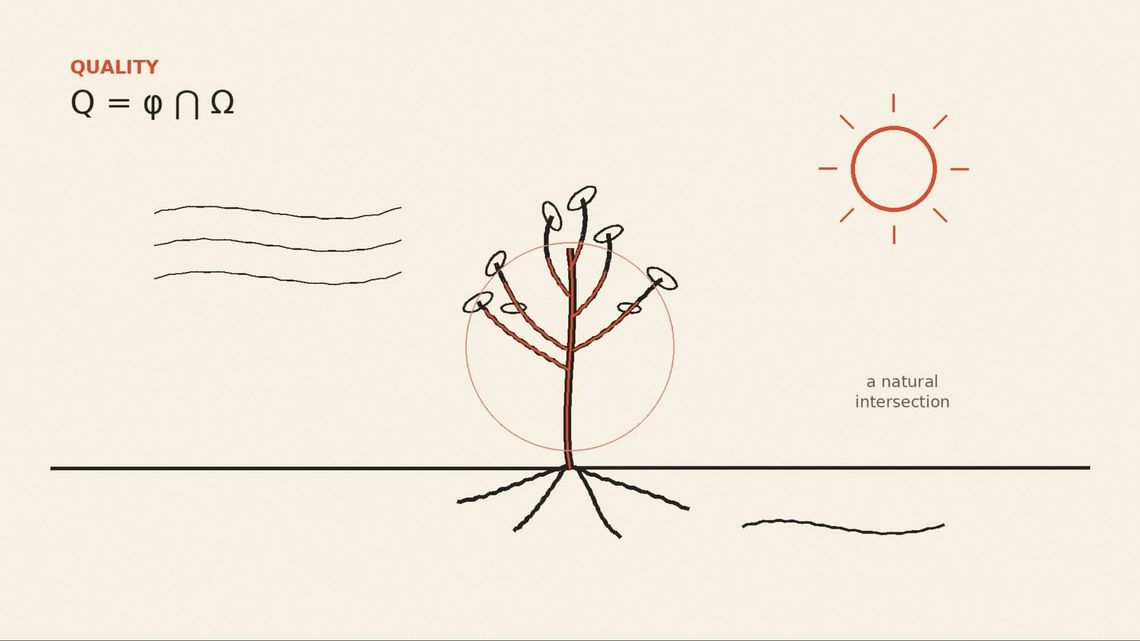
3. QUALITY — Q = φ ⋂ Ω
5QLN: Finding Resonance with the Sun. Self-nature finds natural intersection with universal potential — the felt "click" of resonance, not a thought but a felt sense of belonging.
Financial parallels
- Price discovery. The whole function of a market is to produce φ ⋂ Ω. Private view (φ, the analyst's thesis) meets public market (Ω, the aggregate of every other participant's thesis) at the moment of trade. The "click" is the transaction itself — the felt moment when the bid and the offer lock and a price is printed. 5QLN's language ("not a thought, but a felt sense of belonging") is unusually apt for what traders describe as "the market finding its level."
- Margin of safety. Graham's margin of safety is the operational form of the ⋂ operator. When an asset's price falls materially below its intrinsic value, the gap between φ (private estimate of worth) and Ω (public price) becomes wide enough that the investor feels the resonance of rightness — the "click" of mispricing that can be acted on. Graham's insistence that the margin must be "wide enough to absorb unfavorable developments" is the requirement that the intersection be deep, not shallow.
- Mr. Market. Buffett's retelling of Graham's Mr. Market parable reframes the ⋂ as a daily opportunity rather than a one-time event. Mr. Market arrives every day with a different quote; your job is to wait until his price (Ω) intersects your view of value (φ) on terms that produce the felt sense of rightness. The intersection is not forced; it is recognized when it appears.
- Fair value and the cost of capital. In corporate finance, the moment of eurythmia arrives when a project's internal rate of return intersects the company's cost of capital. Below the hurdle, no resonance; above it, value-creating resonance. The ⋂ operator is the NPV decision rule itself: invest when the project's nature (its cash flows) aligns with the universal law of the cost of capital.
- Reflexivity — and the moment before it. Soros's reflexivity describes what happens after the click: once a price moves, it changes the fundamentals it reflects, producing self-reinforcing loops. QUALITY is the moment before reflexivity takes over — the felt rightness of the alignment itself, uncontaminated by feedback. The investor who can tell the difference between a true ⋂ and a reflexive loop has the edge.
Practice: When the thesis is right, you will feel it before you can model it. Trust the felt sense of margin of safety; it is the intersection of your judgment with the price the market has offered.
4. POWER — P = δE/δV → ∇
5QLN: The River of Effortless Flow. The ratio of effort to value reveals the natural gradient — effortless flow, the river carving without force.
Financial parallels
- The Sharpe ratio. The Sharpe ratio is the literal δE/δV of portfolio theory: excess return (E) per unit of volatility (V). The whole discipline of risk-adjusted return is the working drawing of the 5QLN equation. A high-Sharpe strategy is not necessarily a high-return strategy; it is one in which a small amount of risk-taking produces a large amount of compensated return — the minimum-intervention, maximum-result configuration that 5QLN calls ∇.
- The Kelly criterion. Kelly's 1956 formula for optimal bet sizing is the formal version of δE/δV → ∇ in the presence of repeated bets. It sizes each position to maximize the geometric growth rate of capital — the long-run slope of the compounding curve — without forcing. Kelly-sized bettors do not push capital at the market; they let the gradient reveal the optimal exposure. A fractional-Kelly bettor explicitly trades some expected return for a smoother path, an admission that the gradient includes the investor's own psychology.
- The carry trade. The currency carry trade is the purest market instance of finding the gradient and riding it. Borrow in the low-yielding currency, invest in the high-yielding currency, collect the spread. There is no prediction of direction; there is only the slope of yield differentials. The slope ∇ is the carry; the trader does not push the market, only receives and transmits.
- Convexity and option gamma. A long option position pays a small premium (δE) for a potentially large convex payoff (δV) when the underlying moves. The literal optimization of δE/δV — the smallest intervention producing the largest nonlinear result. Taleb's "barbell" strategy (small allocation to extreme convexity, large allocation to cash) is a portfolio constructed around the ∇ of convex payoffs.
- Buffett's "fat pitch" and trend following. Buffett's discipline of swinging only at fat pitches is the qualitative version of δE/δV → ∇. Wait for the configuration in which the smallest commitment of capital produces the largest expected return. Trend followers operationalize the same idea: they do not predict the direction of the market; they ride the slope once it has revealed itself. "Price is what you pay, value is what you get" (Buffett) is the gradient between price and value, and return flows along that gradient as water flows downhill.
Practice: Do not push the market; find the angle at which the carry already wants to flow. The Sharpe ratio is not invented — it is discovered. Your trade is the discovery, not the imposition.
5. VALUE — V = L ⋂ G → ∞
5QLN: The Gift of the Fruit and the Forest. Local actualization (the apple) intersects with global propagation (the seeds) → inexhaustible, self-multiplying benefit.
Financial parallels
- Compounding. Einstein's apocryphal "eighth wonder of the world" is the literal mechanism of L ⋂ G → ∞. A local coupon (L) intersecting with time (G) produces exponential, non-depleting value (→ ∞). The first dollar compounded at 6% for two centuries becomes $115,000. The local fruit (one year's interest) intersecting with global propagation (reinvestment across decades) becomes an inexhaustible forest. Buffett's entire fortune is the worked example: ~99.5% of his net worth was created after age 56.
- The dividend. The dividend is the apple. The cash paid out is the local, tangible gift — you can hold it, spend it, receive it. The seeds within the apple are the reinvested earnings of the payer, the new plants the company builds with the retained portion, and the new positions the recipient takes with the cash. Where the tangible fruit and its infinite potential meet (⋂), value becomes endless (→ ∞). The dividend does not deplete the company; it multiplies across the ecosystem of holders.
- The insurance float as L ⋂ G → ∞. Berkshire's insurance float is the textbook financial instance of the equation. Local premiums (L), collected today, are invested in global holdings (G) that compound for decades (→ ∞). A single dollar of float, invested well, becomes a forest of equity stakes, bond portfolios, and wholly-owned subsidiaries. The local gift (this year's premium) propagates as a forest (the entire holding company).
- The open-ended fund. The legal structure of the mutual fund and the ETF is designed for non-depleting propagation. Local value (one investor's capital, one underlying security) intersects with global access (millions of investors, instant liquidity) and multiplies. The fund does not lose value by being held by more people; it gains, every time, in scale and liquidity. Bogle's index fund is the purest case: a single local recipe (cap-weighted ownership of the market) that has propagated across trillions of dollars and millions of portfolios without ever being used up.
- The endowment. Yale's endowment, and Buffett's gift to the Gates Foundation, are designed to fulfill L ⋂ G → ∞ literally: spend only the real return above inflation, leave the principal to compound, and the gift propagates across generations. The endowment structure is the legal form of 5QLN's "gift that never depletes the source." Local spending in each year (L) intersecting with global propagation across centuries (G) produces inexhaustible benefit (→ ∞).
Practice: Build something specific enough to pay a coupon in its year, and general enough to compound across decades. The dividend is your local work; the float, the index, and the open structure are the seeds you leave behind for the next investor.
A Note on the Convergence
Both 5QLN and the financial tradition refuse the modern split between maker and made. The investor does not "invent" the price; the price was always latent in the order book, the position, and the law of risk and return. The 5QLN practitioner does not "invent" the question; the question was always latent in the silent field of not-knowing. Where Graham says margin of safety, 5QLN says felt resonance. Where Markowitz says risk-adjusted return, 5QLN says the natural gradient. Where Buffett says the first dollar compounds for two centuries, 5QLN says the apple is the forest.
The equations are different alphabets. The market they point to is one. The CAPM is the architect's modulus translated into risk premia; the margin of safety is the eurythmia of price discovery; the Kelly criterion is the catenary drawn on the graph of geometric growth. Both systems insist that nothing is added from outside — what arises is what was always already there, latent in the cash account, the order book, and the law of compounding.
The risk is that the financial vocabulary, because it is so quantitative, obscures the phenomenological arc it points to. A Sharpe ratio of 1.4 is a number; the discovery of the gradient that produces it is an act. The point of the mapping is not to teach finance a new trick, but to remind finance of what it has always been doing under the surface of its formulas: sitting with the cash account, unfolding a thesis, recognizing resonance, riding the gradient, leaving behind a forest.
The seed was always the forest. The first dollar was always the endowment.
Sources
- 5qln.com/start, /growth, /quality, /power, /value. Amihai Loven, 2025–2026.
- Benjamin Graham, The Intelligent Investor (1949, rev. 1973).
- Warren Buffett, Berkshire Hathaway Shareholder Letters, 1957–present.
- Harry Markowitz, "Portfolio Selection" (1952).
- William F. Sharpe, "Capital Asset Prices" (1964).
- Eugene Fama and Kenneth French, "Common Risk Factors in the Returns on Stocks and Bonds" (1993).
- John Kelly, "A New Interpretation of Information Rate" (1956).
- George Soros, The Alchemy of Finance (1987).
- Benoit Mandelbrot, The (Mis)behavior of Markets (2004).
- David Swensen, Pioneering Portfolio Management (2000).
- Nassim Taleb, Antifragile (2012).