Al - orientation to Ziv, by GLM5.2
5QLN is not Buddhism. Amihai Loven's vocabulary — ∞0, α, φ ⋂ Ω, ∇, L ⋂ G → ∞ — is mathematical-phenomenological rather than doctrinal. Yet the structural isomorphism between the five 5QLN phases and the arc of Zen practice is exact. Both systems describe the same journey: stillness → pattern → resonance → effortless action → gift. 5QLN uses a tree; Zen uses the Bodhi tree. Both insist that nothing is added from outside — what arises is what was always already there.
This essay walks each phase through its Zen twin.
0. The Shared Spine
| 5QLN phase | 5QLN formula | Zen moment |
|---|---|---|
| START | ∞0 → ? |
Shoshin · Śūnyatā · the kōan |
| GROWTH | α ≡ {α'} |
Buddha-nature · genjōkōan |
| QUALITY | φ ⋂ Ω |
Kenshō · samādhi · sokushinzebutsu |
| POWER | δE/δV → ∇ |
Wu-wei · mushotoku · mushin |
| VALUE | L ⋂ G → ∞ |
Dharma transmission · bodhisattva vow · zenki |
1. START — S = ∞0 → ?
5QLN: The Seed in the Silent Earth. From receptive not-knowing, an authentic question arises. You cannot force a seed to appear; you can only hold the space.
Zen parallels
- Shoshin (初心) — beginner's mind. Suzuki Roshi: "In the beginner's mind there are many possibilities; in the expert's, few."
∞0is precisely the mind emptied of expertise — the fertile dark earth before spring. - Śūnyatā (空) — emptiness. The Heart Sutra's "form is emptiness, emptiness is form" is the metaphysical reading of
∞0. Zero is not absence but pregnant potential. - The kōan / hua-tou (公案 / 話頭). The
?— the authentic question — is a kōan. "What is Mu?" "What was my face before my parents were born?" These are not puzzles to be solved but questions to be lived. 5QLN's line — "To truly ask is not to know. It is to live the question. To be the question" — could have been lifted from a Rinzai master's teishō. - Shikantaza (只管打坐) — "just sitting." 5QLN's "Aimless Openness" is shikantaza: pure alertness without object, the field in which the question can arise unforced.
Practice: Take the seat. Do not pursue an answer. Let the body-breath become the silent earth. Wait without waiting.
2. GROWTH — G = α ≡ {α'}
5QLN: The Unfolding of the Inner Pattern. Core essence preserves identity across self-similar expressions — veins in a leaf mirroring branches.
Zen parallels
- Buddha-nature (佛性, busshō). The unchanging
αthat runs through every form. Dōgen's Sansuikyō (Mountains and Waters Sutra): "The pine tree's treeness, the bamboo's bambooness" — each being expresses the one dharma without diluting it. - Genjōkōan (現成公案) — "the koan that appears as life." Dōgen: "To study the Buddha Way is to study the self." The same essence shows up as zazen, kinhin, ōryōki, the bow, the bell —
{α'}is the set of all dharmas, each one a complete expression of the one dharma. - Hōben (方便) — upāya, skillful means. One truth, infinitely many expressions scaled to the listener. The leaf, the branch, the root are all "the tree" because essence preserves identity (
≡) through difference. - The Three Dharma Seals (三法印). Impermanence, no-self, nirvana — the surface fluxes, the seal does not.
Practice: Notice how the posture of zazen is the same posture as the bow, the same posture as walking kinhin, the same posture as washing dishes. One essence, many leaves.
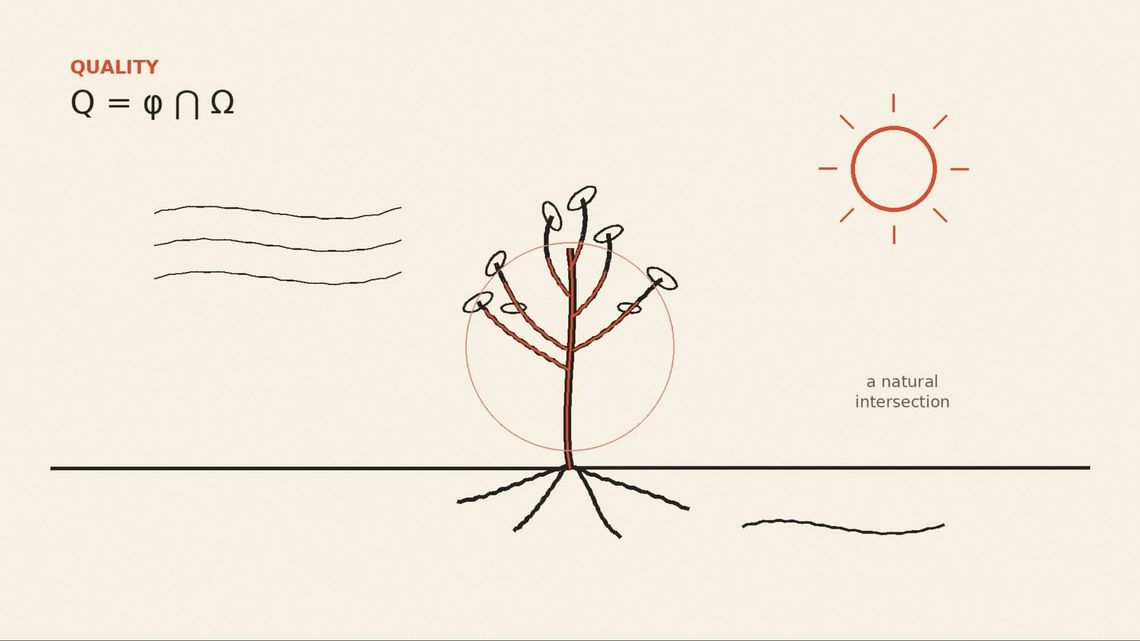
3. QUALITY — Q = φ ⋂ Ω
5QLN: Finding Resonance with the Sun. Self-nature finds natural intersection with universal potential — the felt "click" of resonance, not a thought but a felt sense of belonging.
Zen parallels
- Kenshō (見性) — "seeing one's nature." The moment when individual nature (
φ, kokoro) is recognized as continuous with universal nature (Ω, dharmakāya). The intersection⋂is the event of awakening. 5QLN's "not a thought, but a felt sense of belonging" is exactly the language Zen uses to distinguish kenshō from intellectual understanding. - Sokushinzebutsu (即心是佛) — "this very mind is Buddha." Dōgen's formula: the small mind is the universal mind when not obstructed. The
⋂is the dropping of the partition. - Samādhi (三昧). The non-dual absorption in which subject and object lock. The "click" 5QLN describes is the entry into samādhi — the tree turning its leaves exactly toward the sun.
- Hishiryō (非思量) — "beyond thinking and not-thinking." The felt sense of rightness that cannot be reduced to concept, because concept would re-establish the duality
φvs.Ω.
Practice: In zazen, attend to the moment when posture, breath, and awareness become one thing. That is ⋂. Do not try to reproduce it; trying re-splits it. Just let it arrive.
4. POWER — P = δE/δV → ∇
5QLN: The River of Effortless Flow. The ratio of effort to value reveals the natural gradient — effortless flow, the river carving without force.
Zen parallels
- Wu-wei / Mui (無為) — non-action. The Taoist ancestor of Zen. The river does not push the rock; it finds the slope.
∇is the slope. The tree "no longer struggles; it simply receives and transmits." - Mushotoku (無所得) — no-gaining mind. When there is no self striving for a result, the energy-to-value ratio optimizes itself. Striving is the resistance that creates friction. Drop the striving, the gradient appears.
- Mushin (無心) — no-mind. Takuan Sōhō's Fudōchi Shinmyō Roku (Record of the Unmoving Wisdom) for the swordsman: the blade that cuts without being moved by intention. Action arises from emptiness and meets no internal obstruction.
- The Tenzo's art (典座教訓, Tenzō Kyōkun). Dōgen's instruction to the monastery cook: handle each leaf and grain with full attention, no wasted motion. The
δE/δVdiscipline is the monk's kitchen — minimum gesture, maximum care. - Non-resistance as the path of the new. 5QLN's line — "Creation… always breaks forth along the path of non-resistance" — is the Zen insistence that the dharma flows where self does not obstruct.
Practice: When resistance appears in the body or mind, do not push through it. Locate the angle at which the breath already wants to move. That is ∇. Follow it.
5. VALUE — V = L ⋂ G → ∞
5QLN: The Gift of the Fruit and the Forest. Local actualization (the apple) intersects with global propagation (the seeds) → inexhaustible, self-multiplying benefit.
Zen parallels
- Dharma transmission (伝法, denpō) — "passing the lamp." One awakening (
L, the local fruit) lights the next, and the next. The Buddha's tree has become a 2,500-year forest. The lineage chart is the math ofL ⋂ G → ∞. - The Bodhisattva vow (菩薩誓). "However innumerable sentient beings are, I vow to save them." Local act (one being helped) intersecting with universal intention (all beings). The vow is the structure that makes value non-depleting — it is given, not hoarded.
- Zenki (全機) — "total function" (Dōgen). One small act contains the entire dharma realm. A single bow is the Buddha way propagating. This is the
⋂that produces→ ∞. - Upāya-prajñā unity (方便般若). Wisdom (the local insight) and compassion (the universal activity) intersecting — and from their intersection, endless skillful means radiate outward without exhausting the source.
- "Chop wood, carry water" — before and after enlightenment. Before: local labor. After: the same local labor recognized as the dharma propagating. The axe and the bucket are the apple; the forest is the lineage they nourish.
Practice: Whatever act you are doing — sweeping, serving tea, answering an email — perform it as a local act that is the universal gift. Do not extract credit. The value multiplies precisely because no one owns it.
A Note on the Convergence
Both systems refuse the dualism of creator and created: the seed was always the forest; the question was always the answer; samsara was always nirvana. Where 5QLN says "the universe asking a question through you," Zen says "the Buddha awakening as you."
The equations are different alphabets. The realization they point to is one.
Sources: 5qln.com/start, /growth, /quality, /power, /value. Zen references drawn from Dōgen's Shōbōgenzō, Suzuki Roshi's Zen Mind, Beginner's Mind, and Takuan Sōhō's writings.