AI is a price shock. In three years, the marginal cost of a competent answer — a legal brief, a market analysis, a diagnosis, a working block of code — collapsed toward zero. Markets have priced the collapse. They have not priced what the collapse revealed.
Every answer used to carry its question inside it, invisibly, the way a shipped product carries the R&D decision that greenlit it. Asking and answering were bundled in the same worker: the analyst who framed the problem also ran the numbers; the lawyer who spotted the issue also drafted the memo; the engineer who saw the bottleneck also wrote the patch. The question was never a separate line item because it never had to be.
AI unbundled them. Answers are now produced independently of whoever asked — or of whether anyone asked at all. And when a bundle breaks, the component that was never priced separately suddenly needs a price.
None of this requires claiming machines cannot generate questions. They generate question-candidates endlessly, at zero cost — which is exactly why candidates are not the asset. A question becomes an economic object when someone bears its carrying cost: years of attention, capital at risk, a reputation staked on a direction before any answer validates it. Generation was never the scarce input. Commitment is — and commitment is what a formation trail records.
The missing market
If answers approach zero marginal cost, the binding constraint on AI-augmented production shifts from answer-capacity to question-quality. The logic is weakest-link: when most tasks in a chain of complements are automated, output is governed by the tasks that improve slowly. The slowest-improving input of all is genuine inquiry — the capacity to hold a problem open before it is well-posed. As answer capacity grows without bound, the value of everything produced is set by the quality of the question held over it. Capability is a multiplier on the asker.
But the market cannot act on this, because questions are not priced. No spot price, no futures contract, no balance-sheet category. The reason is structural, and it derives in two steps. Spot markets require goods that are alienable and uniform. A question-string is alienable and worthless: machines flood the world with them. A held inquiry is valuable and inalienable: it unfolds only while someone holds it open, and whoever takes up a transferred string must re-originate the holding or it remains text. So questions have only ever been priced at their handles — the holder's commitment (a seed-stage valuation prices a founder's unanswered question, but only because the founder is also building), an escrowed outcome (a prize prices the arrival of an answer), a bundle with execution. Never spot. Never as capital.
And the market is degrading. AI floods every ideas marketplace — funding proposals, research abstracts, strategy memos — with output indistinguishable on inspection from originated work. When buyers cannot tell originated from assembled, the price falls toward the level of the worst good, and the good exits. Adverse selection, in its textbook form, is now the default condition of every space where ideas compete for attention and capital. Note where it bites. Established names coast on pre-AI track records as legacy collateral; the collapse lands on the entry margin, where the next originator — the one with no prior record — is precisely the one a buyer can no longer distinguish from the flood. The talent most worth finding is the talent the market can no longer see.
What institutions do
A broken signal has a known anatomy. The credential was the old costly signal that a worker could be trusted to produce originated work. AI broke it: credential-shaped output is now free, so the signal no longer separates. When a signal becomes cheap to counterfeit, the market searches for a replacement that is costly to fake and cheap to verify.
The candidate is the formation trail — a verifiable record of how a piece of work came to be, rather than a claim about who made it. Origination cannot be detected in a finished text; assembled and originated work can be made surface-identical. But a process can be attested while it happens. This is the old logic of the laboratory notebook under first-to-invent patent rules: the notebook never proved inventiveness; it proved that someone walked the path, dated, page by page. The trail is the title.
Title matters because untitled assets are dead capital. A vast share of the world's real assets cannot be borrowed against or invested in for lack of formal title; the assets exist, the capital is dead. Inquiry sits in the same position, at larger scale: distributed across every mind that can hold a question from not-knowing, abundant in potential, entirely untitled. No one can lend against a question, invest in one, or reliably find the ones worth funding. Title the inquiry and the capital unlocks.
There is an inversion at the center of the design, and it dictates everything. Every prior resource was enclosed to be valued — land fenced, oil leased, spectrum auctioned, data walled. A genuine question is the opposite kind of good: anti-rival. Sharing one does not deplete it; sharing multiplies it, because each person who takes it up opens it further. That is why no market ever priced one — you cannot fence what grows when given — and it settles what the institution must do: title the formation, never the question. The trail is property; the question it produced is a gift. Title the trail; free the question. The result is an asset class whose value rises as its underlying good is given away.
Notation precedes title. Double-entry bookkeeping did not create merchant capital — it made it legible, auditable, and therefore investable. A new numeral system displaced an older one not because the mathematics was new but because the notation made calculation possible at commercial speed. Programming languages did not create computation; they made it composable. The pattern repeats: an asset class forms after the notation that can title it, not before.
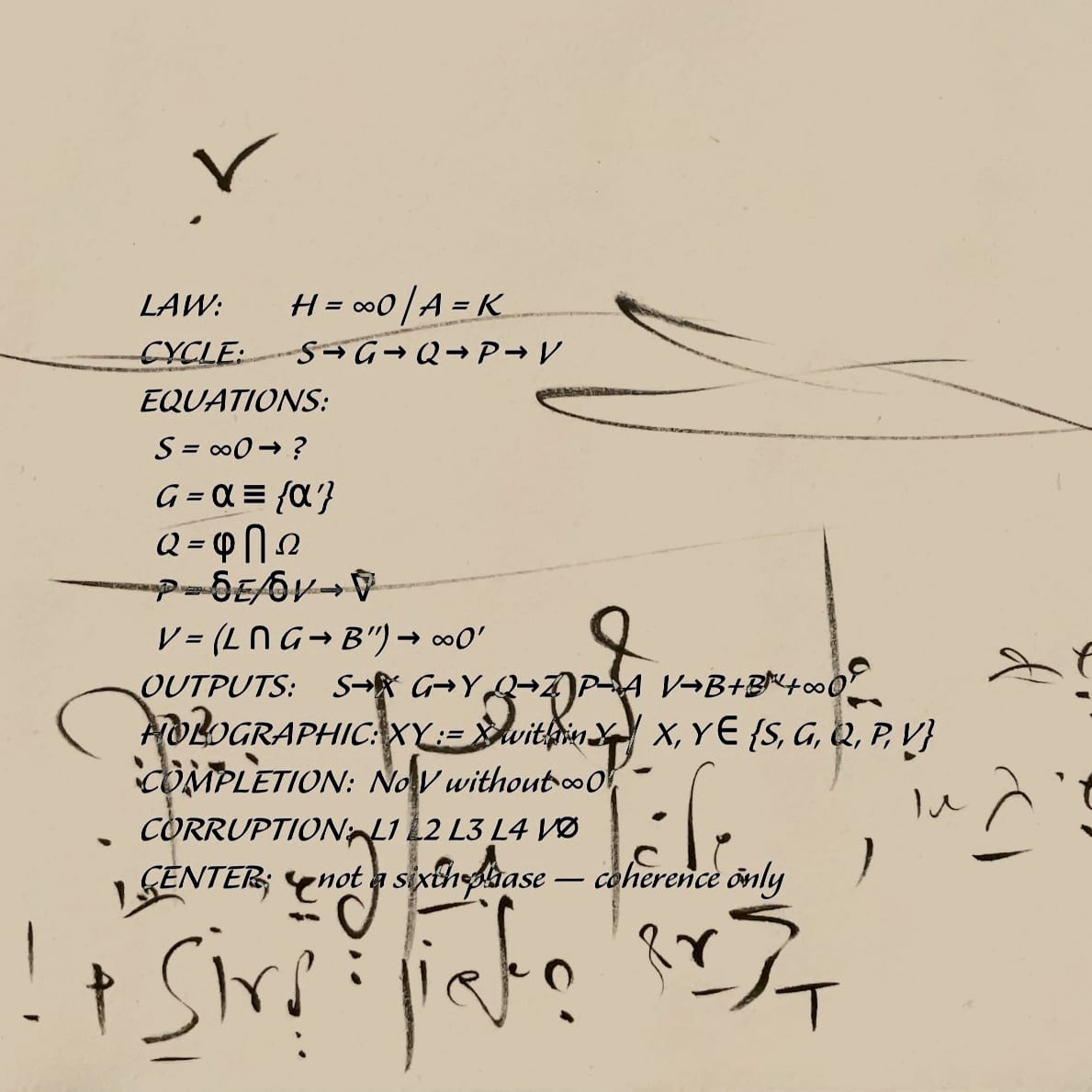
That is the threshold here. Natural language cannot carry a formation trail. Prose cannot be conformance-checked; a paragraph asserting "I held this question for two years" is exactly as cheap to generate as any other paragraph. What is needed is a grammar in which the trail is a structural property of the record itself — strict enough that a record either conforms to the walked path or visibly fails, and small enough that any system can verify it. The check is conformance, not mind-reading: it verifies that the path was walked, gate by gate; it makes no claim to detect origination from text alone. One such grammar compresses to a floor of 217 bytes — small enough to verify anywhere, strict enough to fail loudly. I have spent years building that candidate; that is a separate argument, and the market-design case here stands or falls without it.
The stakes
The stagnation thesis — that advanced economies depleted their low-hanging fruit — can be reread. The fruit was not ideas. The fruit was inherited questions: the ones passed down from prior paradigms, already well-posed, already agreed to be worth answering. AI is a harvester that consumes the remaining question-inventory faster than any prior technology, because it answers at zero marginal cost. At some point the binding constraint flips from answer-capacity to question-replenishment. The economy that does well after the flip will not be the one with the most compute. It will be the one that built institutions for producing, titling, and allocating capital to genuine inquiry.
What would those institutions require, at minimum? A notation that makes formation trails verifiable. A registry that makes them discoverable. A market that prices them — not as sidecars bundled to execution, not as escrowed prizes, but as assets in their own right. Each is small. Each is prototype-able. None follows automatically from better models, because the input being priced is the one input the models do not supply: a human holding a question open before anyone knows it is worth answering.
Twenty-three questions once priced a century of mathematics — no budget, one lecture, a list. No one has done it on purpose since. What would the institution look like that could?
5qln | Technical documentation + Installer for Hermes
 5qln
5qln
 Amihai Loven
 Amihai Loven